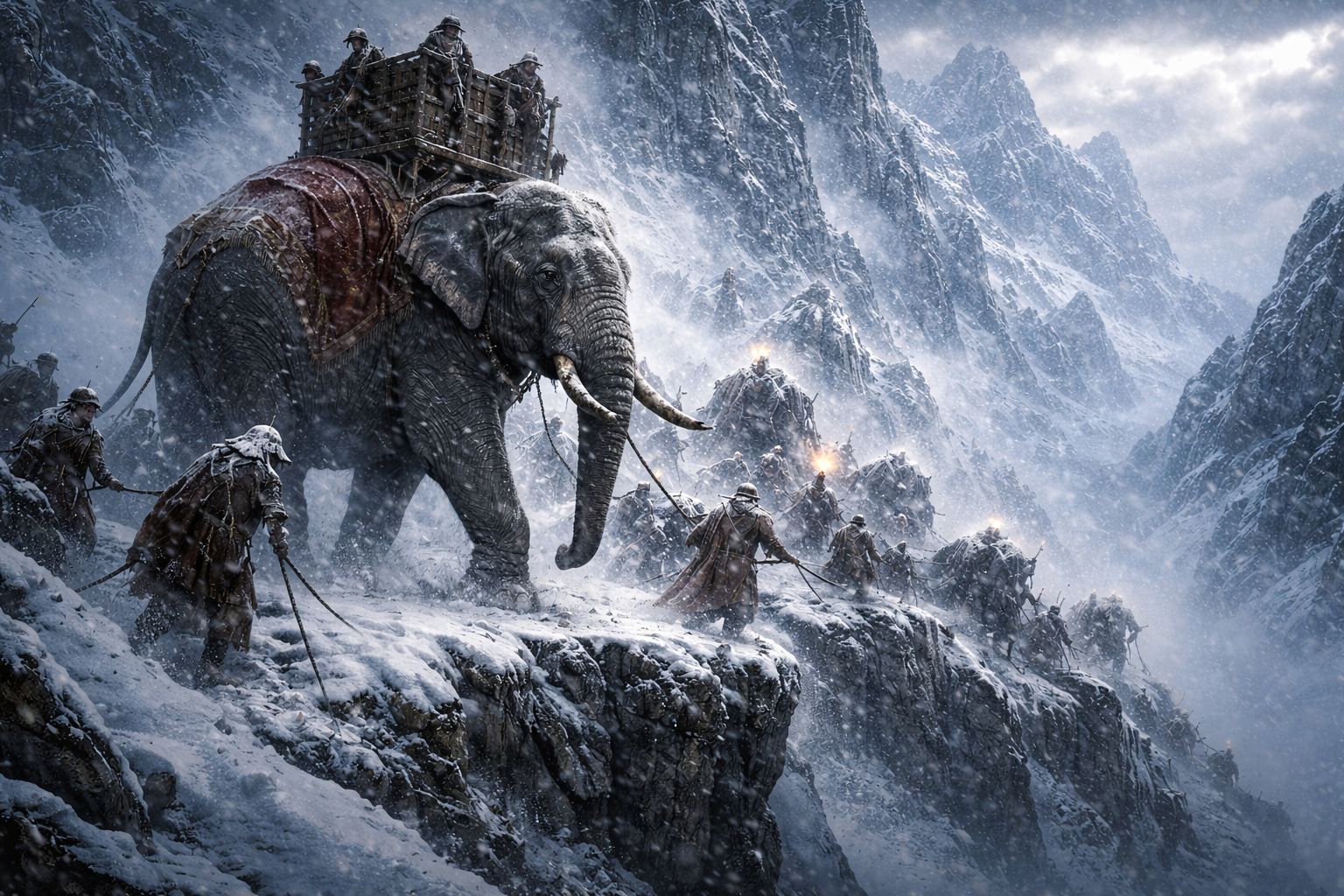
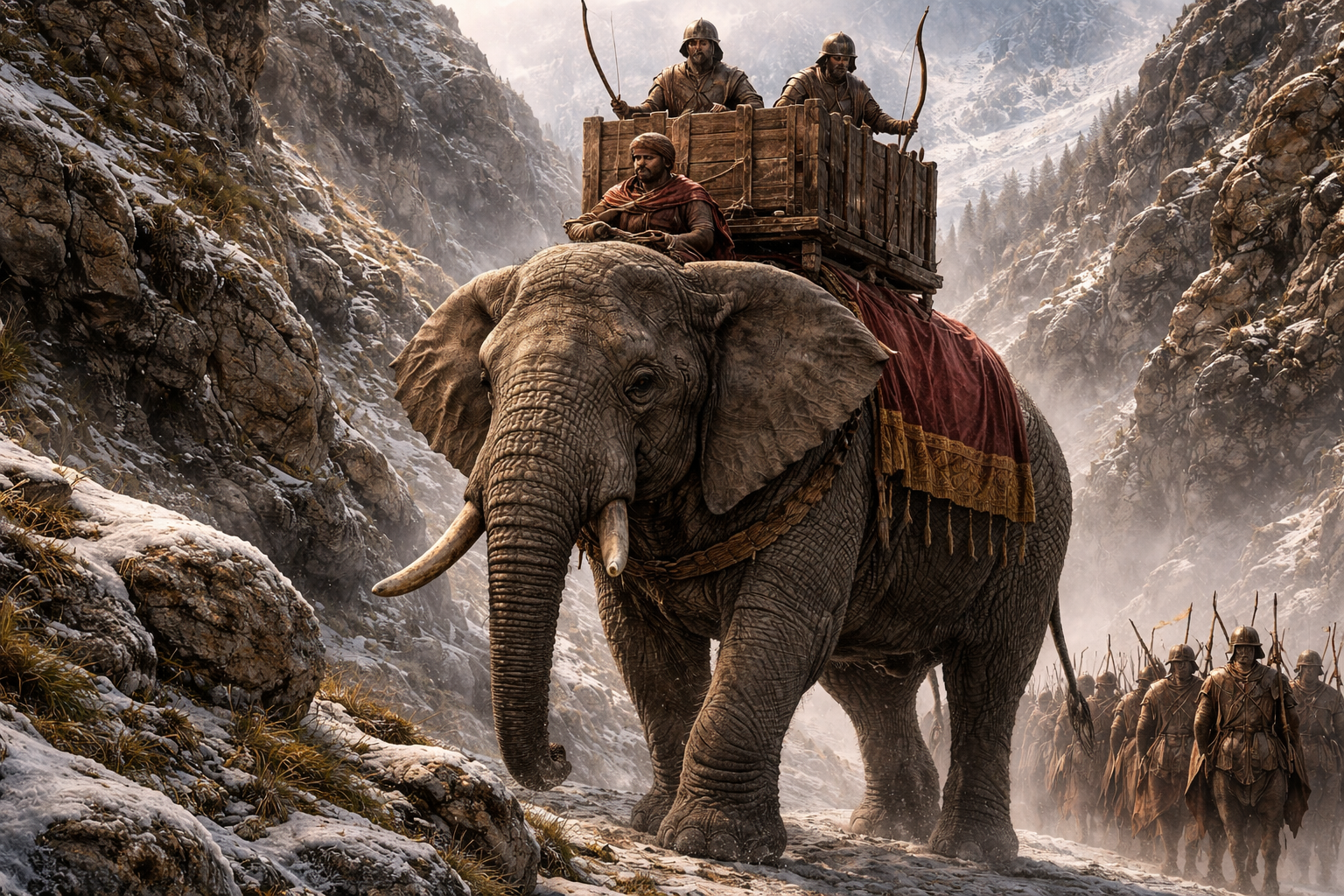
Imagine marching 37 elephants over the tallest mountains in Europe.
Snow up to your waist. Cliffs dropping into nothing. Soldiers from seven different countries, speaking five different languages, following one man — a 26-year-old general from North Africa who swore as a child that he would never be a friend of Rome.
He made it across. And then he started winning.
He won the biggest battle in ancient history. He stayed in enemy territory for fourteen years, undefeated. He came within a few days' march of destroying the most powerful civilization the world had ever seen.
He didn't do it. And because he didn't, everything about your life — the calendar on your wall, the alphabet you're reading, the laws that protect you, the religion your neighbors practice — all of it exists because of that one decision.
But first, you need to understand what he was trying to destroy. ↓
Part IThe Story
🏛️Chapter 1
Wait — What Was Rome?
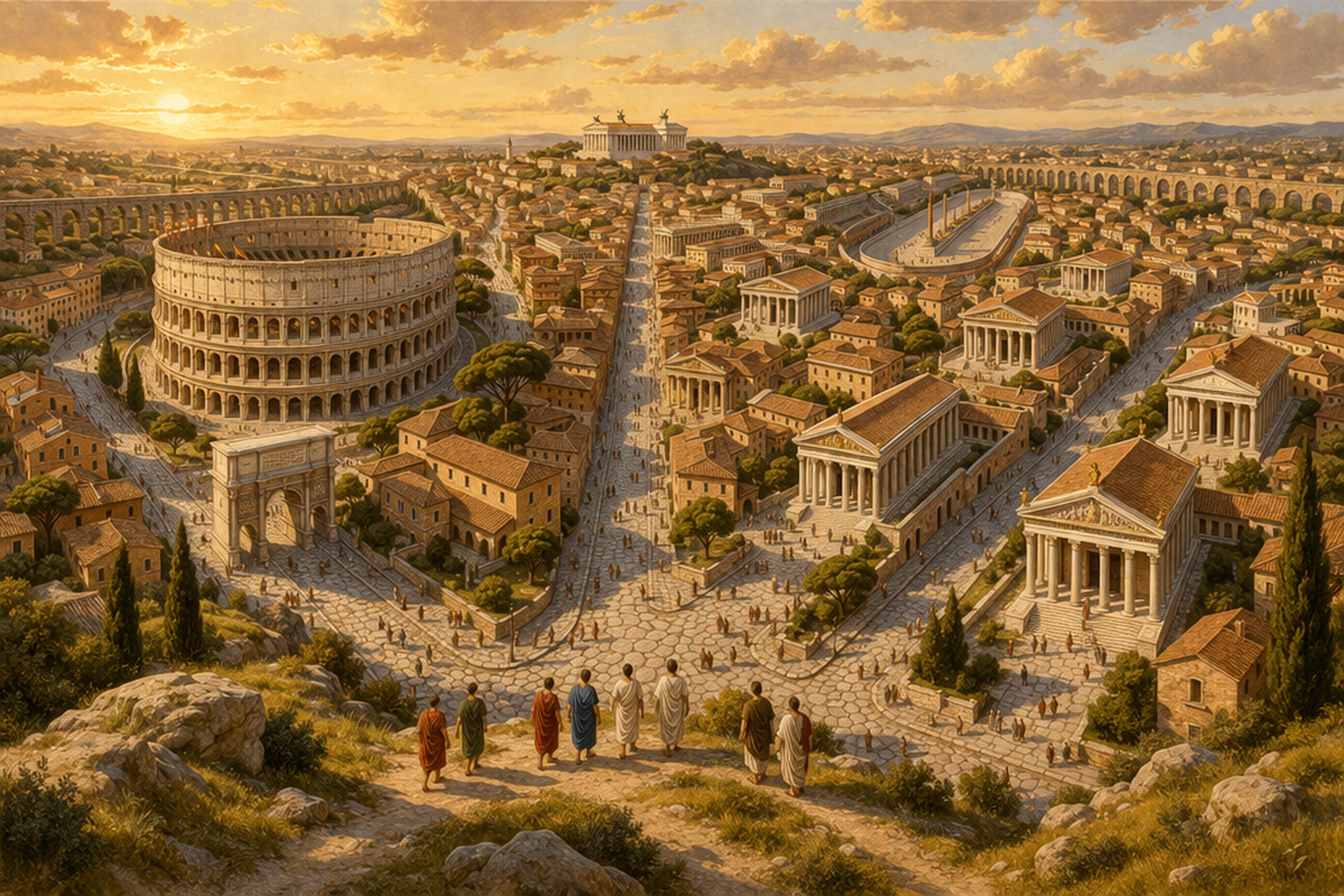
Ancient Rome at the height of its power
Before we talk about what might have been different, you need to understand how much of your everyday life was shaped by one ancient city.
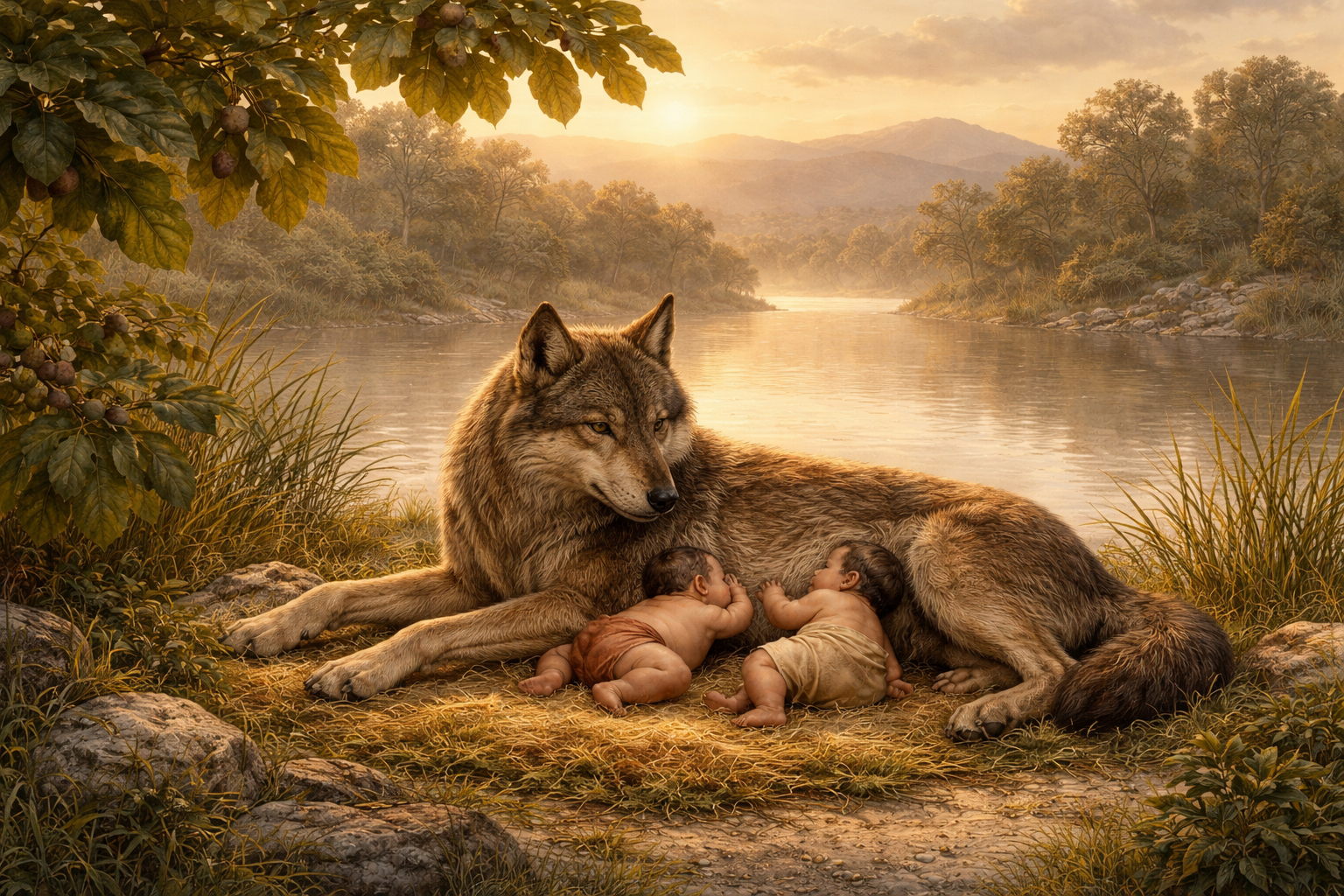
Rome started with a legend. According to the story, twin brothers named Romulus and Remus were abandoned as babies and raised by a wolf. When they grew up, they decided to build a city — but argued about where to build it. Romulus killed his brother and named the city after himself: Roma. Whether or not the story is true (probably not!), it tells you something about Rome from the very beginning: they were willing to fight even each other to win.
From that tiny village on a hill, Rome grew into the most powerful empire the world had ever seen. At its peak, Rome controlled everything from Britain in the cold north to Egypt in the scorching south, from Spain in the west all the way to Iraq in the east. About 60 million people — one in every four humans alive at the time — lived under Roman rule.
🐺 Romulus and Remus ›
The legend says that Romulus and Remus were the sons of Mars, the god of war. They were thrown into the River Tiber as babies but survived, washed up on shore, and were nursed by a she-wolf. Later, a shepherd found them and raised them. The famous bronze statue of the wolf nursing the twins is one of the most recognizable images from the ancient world — you've probably seen it without knowing what it was! Rome's founding date is traditionally given as April 21, 753 BCE.
The legend of Romulus and Remus
🗺️ How Big Was Rome? ›
At its largest, the Roman Empire stretched across three continents. In the north, Roman soldiers guarded Hadrian's Wall in Britain (you can still visit it today in northern England). In the east, they controlled Mesopotamia — modern Iraq. In the south, they ruled Egypt and the entire North African coast. In the west, they held all of Spain and Portugal. The Mediterranean Sea was literally called Mare Nostrum — "Our Sea" — because Rome controlled every inch of coastline around it.
⚔️ The Legionnaire ›
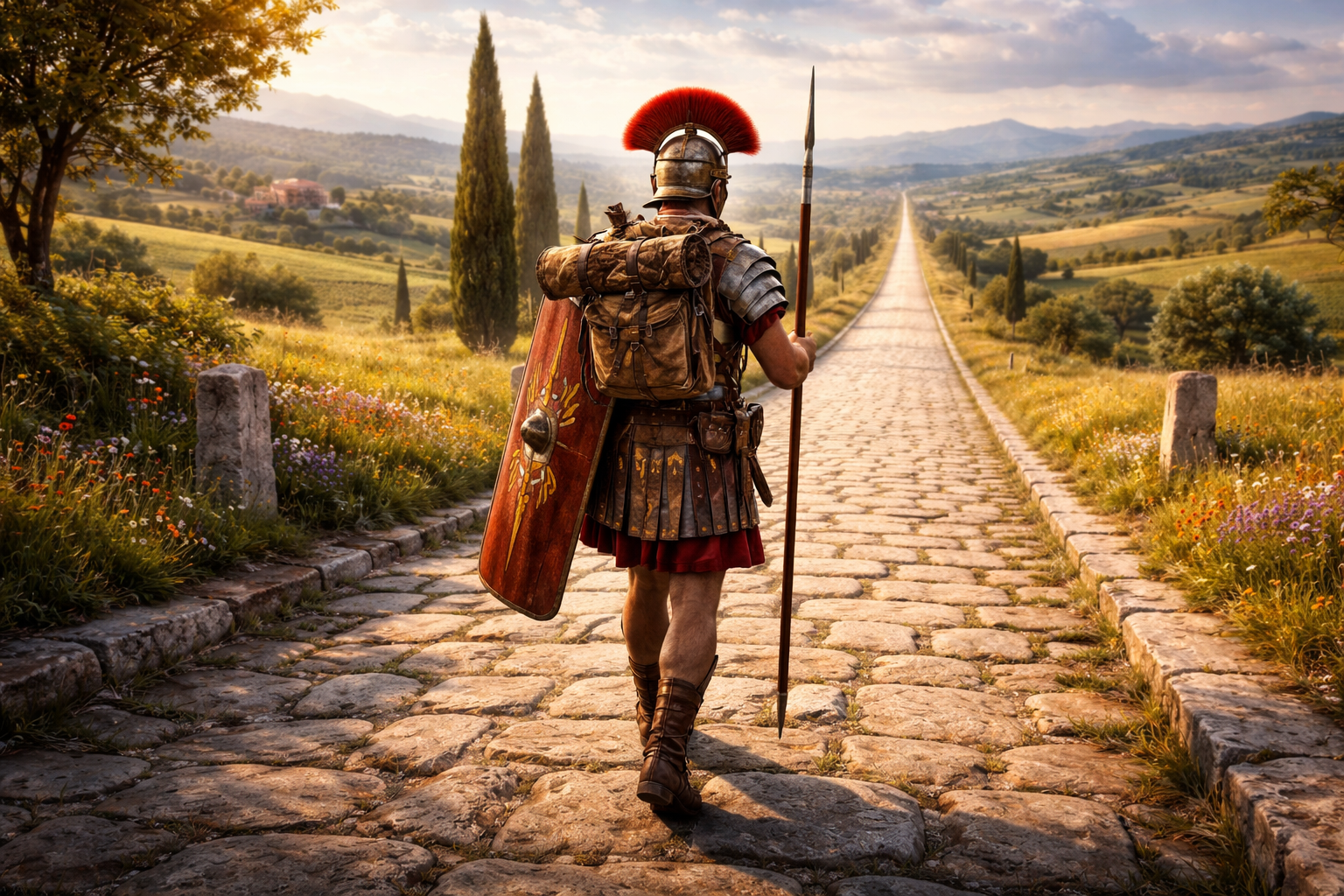
Roman soldiers — called legionnaires — were the most disciplined fighting force in the ancient world. Every legionnaire carried about 30 kilograms (66 pounds) of equipment and could march 30 kilometres (18 miles) in five hours. They built a complete fortified camp every single night when on campaign — with ditches, walls, and gates — then tore it down the next morning and marched on. A full legion had about 5,000 soldiers, and at its peak, Rome had 30 legions. They were so well-organized that the word "legion" still means "a huge number" today.
A Roman legionnaire on the march
But here's the really wild part: Rome never really went away. Even though the Roman Empire fell in 476 CE, its ideas are still everywhere around you — right now, today. You just don't notice because they feel so normal.
📅 The Calendar on Your Wall ›
The months are Roman! January is named after Janus, the Roman god of beginnings. March is named after Mars, the god of war. July is named after Julius Caesar himself. August is named after Emperor Augustus. Even the word "calendar" comes from the Latin word kalendae. Every time you check the date, you're using a Roman system.
🔤 The Letters You're Reading ›
The alphabet you're reading right now is called the Latin alphabet — and Latin was the language of Rome. The letters A, B, C, D... all of them come from Roman writing. English, French, Spanish, Portuguese, Italian, Romanian — they're all descended from Latin. When you text your friends, you're using Roman letters.
⚖️ Laws and Courts ›
The idea that you're "innocent until proven guilty"? Roman. The idea that laws should be written down so everyone can see them? Roman (they carved their first laws, the Twelve Tables, in 450 BCE). The word "justice" comes from Latin. "Legal" comes from Latin. "Constitution" comes from Latin. Most of the legal system that protects your rights was built on a Roman foundation.
🏗️ Roads, Bridges, and Concrete ›
Romans built 250,000 miles of roads — enough to wrap around the Earth ten times. They invented concrete (and some Roman concrete buildings are still standing 2,000 years later, while our concrete starts crumbling after 50 years!). They built aqueducts that carried fresh water for miles using nothing but gravity. The saying "all roads lead to Rome" was literally true.
⛪ Christianity ›
Christianity — the world's largest religion, with over 2 billion followers — spread through the Roman Empire. Jesus lived in Roman-controlled Palestine. The Bible's New Testament was written in Greek (the Roman Empire's second language). Emperor Constantine made Christianity legal in 312 CE, and Emperor Theodosius made it the official religion in 380 CE. Without Rome, Christianity as we know it probably doesn't exist.
So when we say "What if Hannibal won?" we're really asking: what if all of this — the calendar, the alphabet, the laws, the roads, the religion — had developed completely differently? That's why this is such a big question.
Rome's Legacy Today
Our alphabet, our calendar, our legal system, our road networks, Christianity, the idea of "Western civilization" itself — all built on Roman foundations.
Without Rome?
Different writing systems, different calendars, different laws, different religions, different ideas about how to organize society. A world we can barely imagine because Rome is in everything we see.
⚔️Chapter 2
Who Was Hannibal?
Imagine the greatest strategist in history — someone so clever that military schools still study his battles 2,200 years later.
Hannibal Barca was a general from Carthage, an ancient city in North Africa. His father, Hamilcar, was also a famous general. When Hannibal was just a boy — probably around nine years old — his father made him swear a solemn oath: he would never be a friend of Rome.
He kept that promise for his entire life.
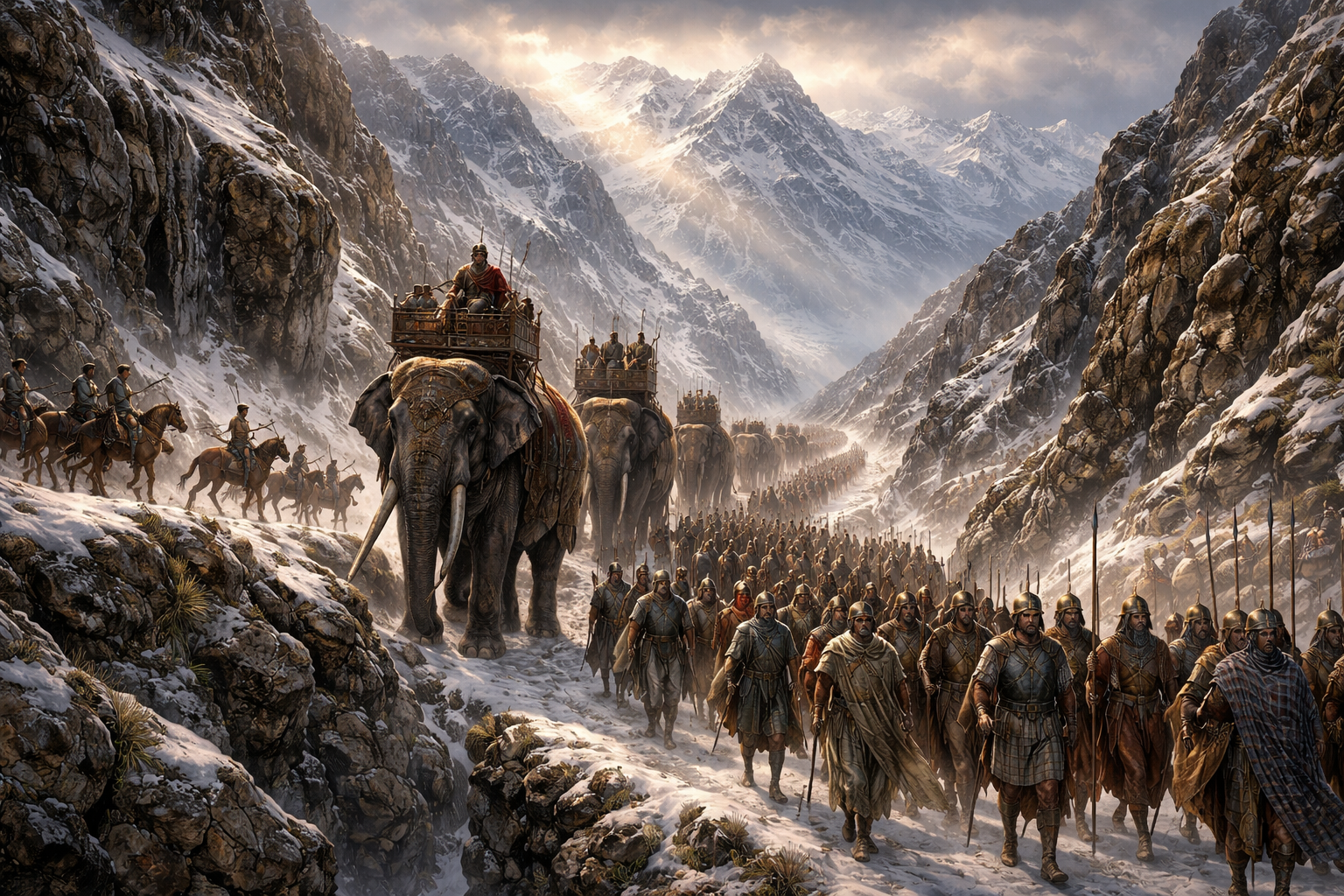
When Hannibal was 26, he did something nobody thought was possible. He gathered an army of 50,000 soldiers, 9,000 cavalry, and 37 war elephants — and marched them over the Alps, the biggest mountain range in Europe, in the middle of autumn. Snow. Ice. Cliffs. Elephants slipping on frozen rocks. He lost nearly half his army on the crossing.
But he made it. And when he came down the other side into Italy, he started winning battles that Rome had never imagined losing.
🌍 The Army of Many Nations ›
Here's what made Hannibal's army truly unique: it wasn't one army — it was dozens of different peoples fighting together. His soldiers came from all across the ancient world:
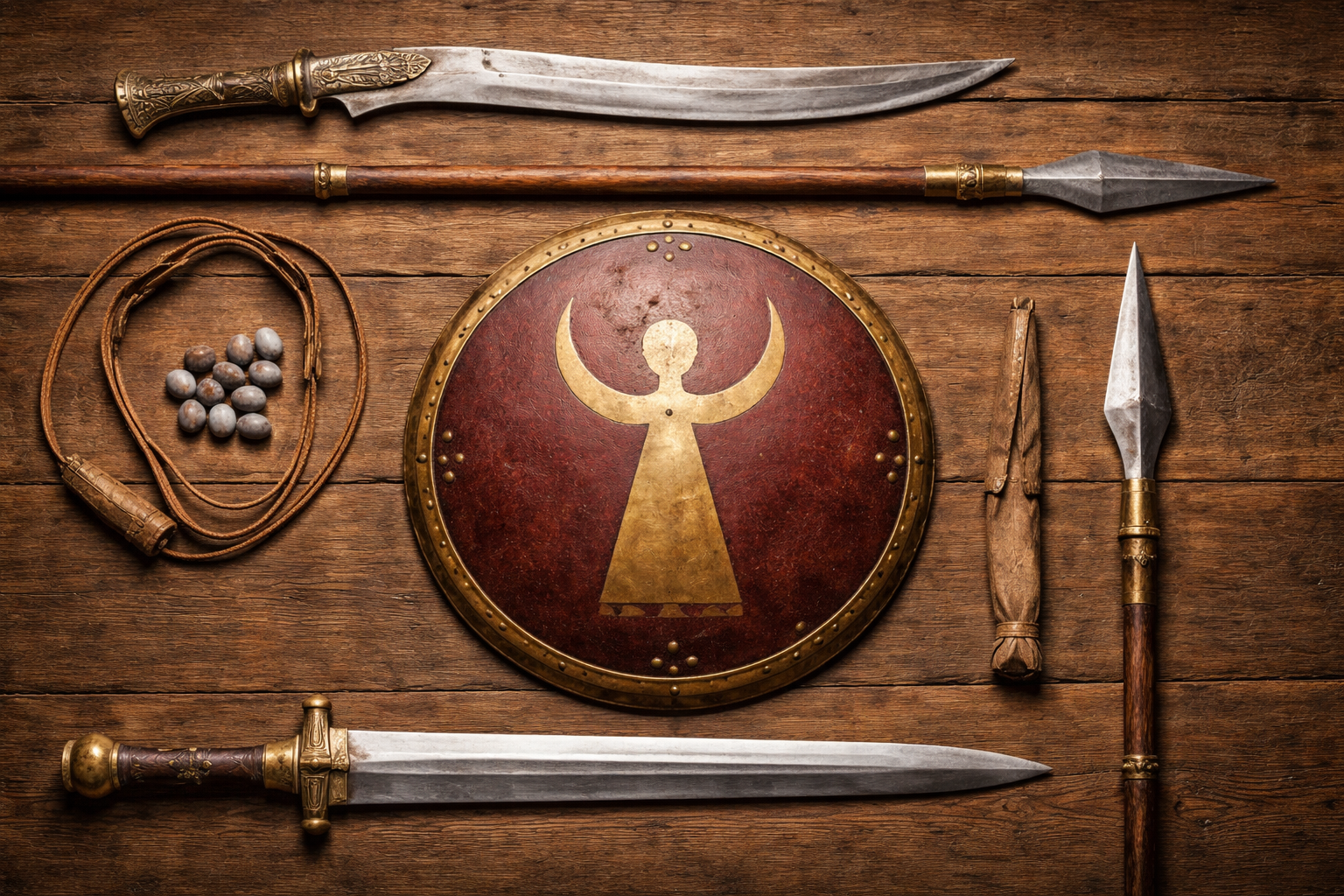
Libyans from North Africa served as his heavy infantry — the armored backbone of the army, often equipped with captured Roman weapons and shields.
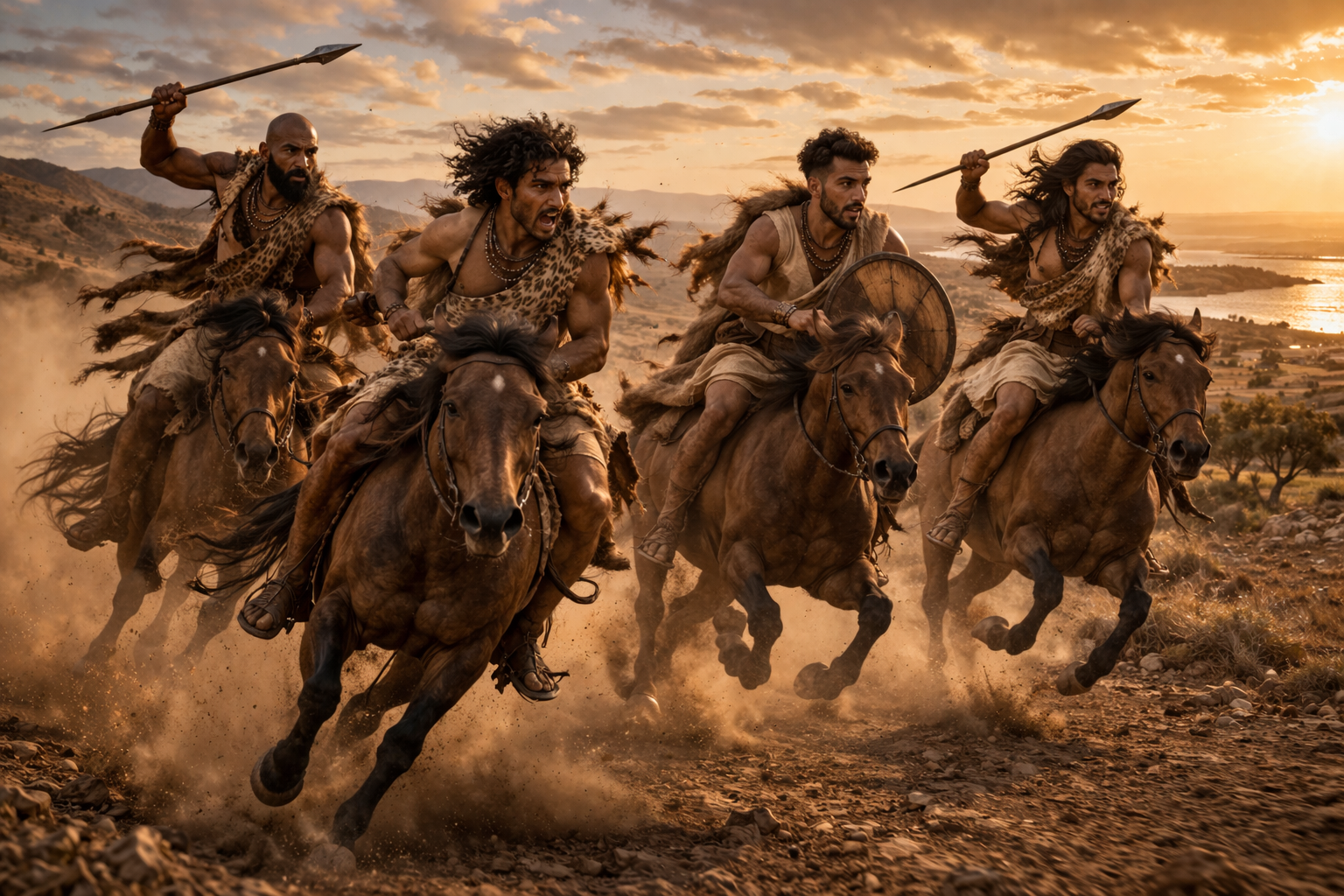
Numidians from modern Algeria and Tunisia provided the deadliest light cavalry in the world, riding without saddles or bridles.
Iberians from Spain fought with the fearsome falcata, a curved sword that could cut through helmets.
Celtiberians from inland Spain brought their own fierce warrior traditions.
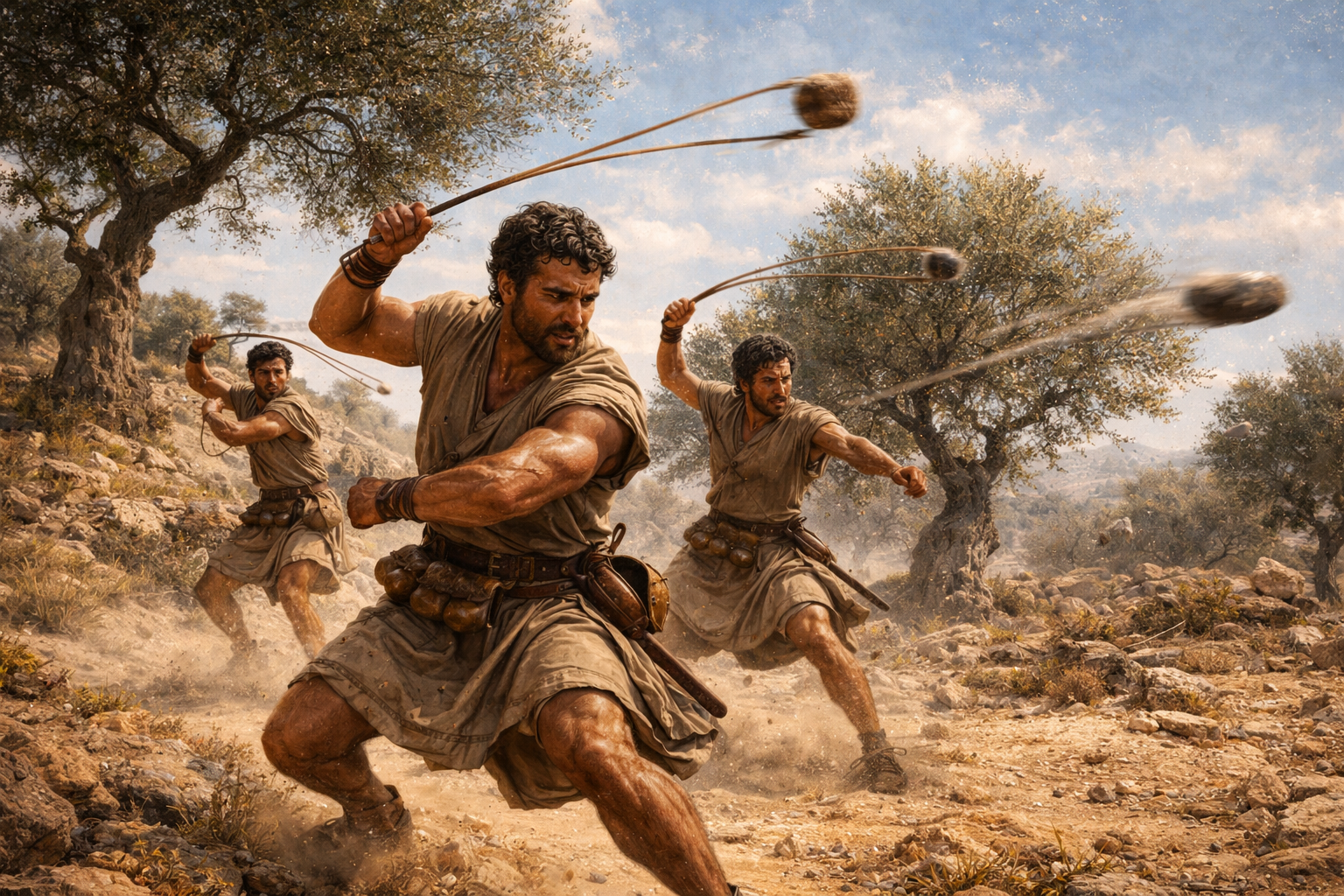
Balearic Islanders from Mallorca and Menorca were the world's best slingers, hurling lead bullets at over 100 mph.
Gauls (Celts) from southern France and northern Italy — tall, fierce warriors who fought bare-chested to show their bravery, with lime-spiked hair and elaborate gold jewelry.
Ligurians from the Italian coast served as tough mountain fighters and javelin throwers.
Compare that to Rome, whose legions were all Roman citizens fighting in the same way with the same equipment. Hannibal's genius was taking soldiers who spoke different languages, worshipped different gods, used different weapons, and came from different continents — and making them fight together as one. That's why he spoke five languages: he needed to talk to all of them. It was like coaching an all-star team where every player came from a different sport, and winning anyway.
🐘 The Elephant Mystery ›
What kind of elephants did Hannibal use? Historians have debated this for centuries! Most of his elephants were probably North African forest elephants — a now-extinct species smaller than the African elephants you see in zoos (about 2.5 metres tall vs. 3.5 metres). Ancient coins from Carthage show these smaller elephants with big ears and curved backs. But Hannibal's personal elephant — named Surus, meaning "the Syrian" — was likely a Syrian elephant, a subspecies of the Asian elephant that also went extinct around this time. Surus was bigger than the others and had one broken tusk. Sadly, North Africa was once home to many amazing animals — including these elephants and the mighty Barbary lion — that were eventually hunted to extinction, partly because Romans used them in arena games.
Surus — Hannibal's personal elephant, likely a Syrian elephant with one broken tusk
🗣️ The Language Master ›
Hannibal spoke at least five languages fluently: Punic (the language of Carthage), Greek, Latin, Iberian (from Spain where he grew up), and likely Numidian (from his North African cavalry allies). This wasn't just impressive — it was a military weapon. He could speak directly to soldiers from different cultures, negotiate with foreign kings, and read captured Roman messages.
🥸 The Master of Disguise ›
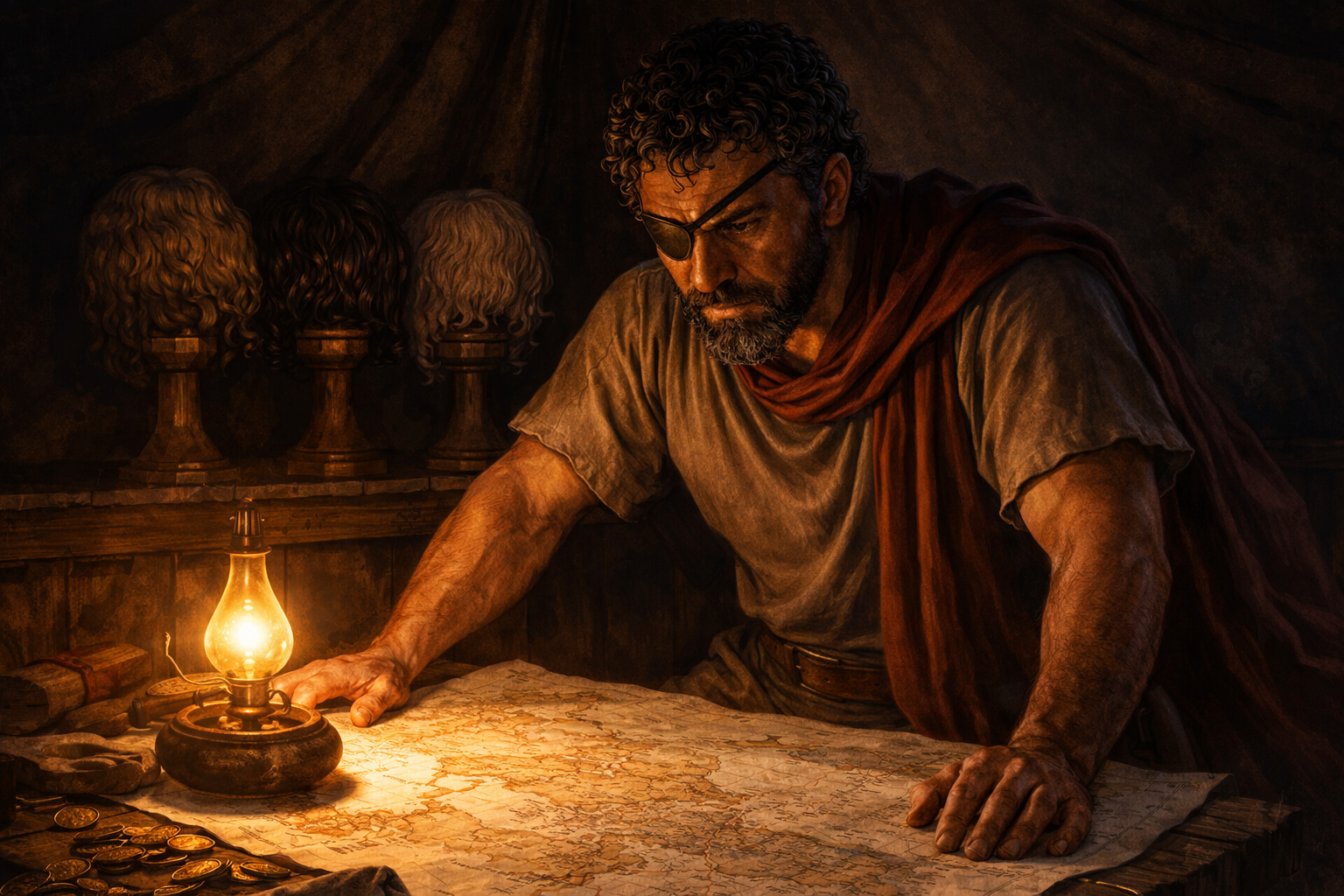
Here's something incredible: the ancient historian Polybius tells us that Hannibal had a collection of wigs made, each designed to make him look like a man of a different age. He would constantly change his appearance — different hair, different clothing — to blend in with his troops and make it nearly impossible for Roman spies or assassins to identify and target him. Imagine: the most wanted man in the ancient world, walking through his own camp, and nobody knowing which one he was!
Hannibal in his tent — with his collection of disguise wigs visible behind himHannibal's army crosses the Alps — elephants, cavalry, and soldiers from across the ancient world
💥Chapter 3
The Biggest Battle Ever
On one afternoon in 216 BCE, more soldiers died than in almost any battle in history.
After crossing the Alps, Hannibal kept beating Roman armies. Rome was scared. They gathered the biggest army they had ever created: 86,000 soldiers, led by two consuls. Their mission: destroy Hannibal once and for all.
The two armies met at a place called Cannae (say it like "CAN-eye") on August 2, 216 BCE.
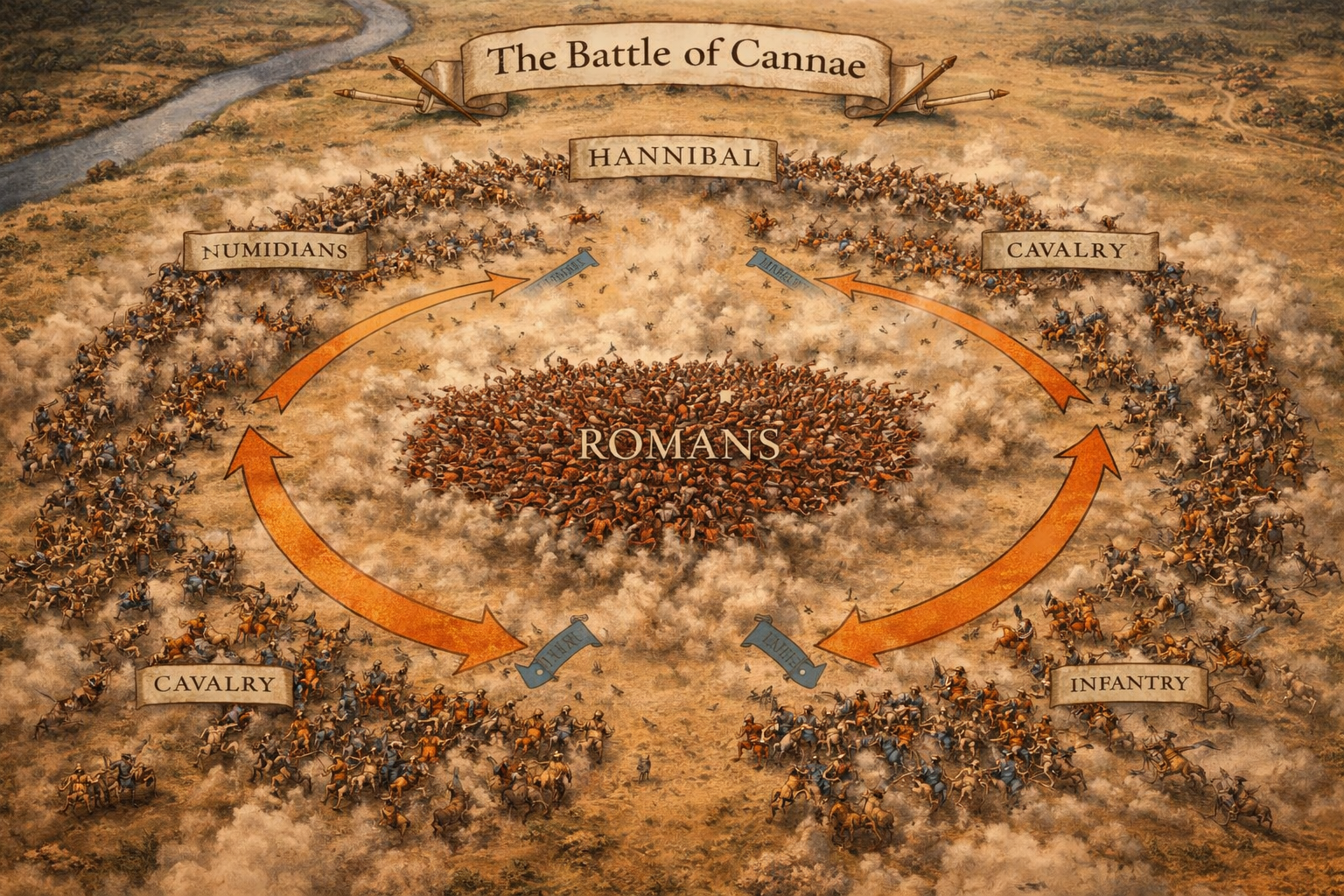
What happened next was the most famous trap in military history. Hannibal put his weakest soldiers in the middle and his strongest on the sides. When the Romans charged forward and pushed the middle back, they thought they were winning. But Hannibal's center was bending on purpose — like a net closing around a fish. His cavalry swept behind them. The Roman army got squeezed tighter and tighter until soldiers couldn't even lift their swords.
70,000
Roman soldiers killed in a single afternoon
To put that number in perspective: Cannae is believed to be the highest loss of human life in a single day of battle in all of recorded history. More people died in those few hours than on the first day of the Battle of the Somme in World War I (1916), which is considered one of the bloodiest days in modern warfare. And this was done with swords, spears, and bare hands — not guns or bombs.
🔬 Try This!
Get 86 coins (or buttons, or pieces of cereal). Line them all up. Now take away 70 of them. Look at what's left. That's what happened to the Roman army in a single afternoon.
The Battle of Cannae — Hannibal's trap closes around the Roman army
🤔 Maharbal's Famous Words ›
After winning this incredible battle, Hannibal's cavalry commander Maharbal begged him to march straight to Rome and finish the war. When Hannibal said no — he needed time to think — Maharbal said something people still remember 2,200 years later: "You know how to win a victory, Hannibal. You just don't know how to use one." Hannibal never marched on Rome. He spent 14 more years in Italy, winning battle after battle, but the war slowly slipped away. Was Maharbal right? That's the question this whole story is about.
🧠 What Would YOU Do?
You've just won the biggest battle in history. Your army is exhausted but victorious. Rome is 250 miles away, with almost no soldiers left to defend it. Your best cavalry commander says: march now, and in five days we'll be eating dinner in Rome. But you have no siege equipment, your soldiers need rest, and you've never lost a battle — so why risk everything on one gamble? Do you march? Or do you wait? Think about it. Your answer might have changed the entire world.
🏅 Still Studied Today ›
The Battle of Cannae is still taught at military academies like West Point (in the United States) and Sandhurst (in England). General Norman Schwarzkopf studied Hannibal's tactics before planning Operation Desert Storm in 1991. The German military strategist Alfred von Schlieffen based his entire World War I plan on Cannae's double envelopment. 2,200 years later, generals are still trying to copy Hannibal's homework!
🎭Chapter 4
How Rome Actually Won
Rome didn't beat Hannibal with a better general. They beat him with a better politician.
After Cannae, a young Roman officer named Scipio — who had survived the battle as a teenager — spent years studying Hannibal's methods. But what Scipio really learned wasn't tactics. It was something new: how to be a celebrity.
Scipio told people that the god Jupiter spoke to him directly. He made dramatic visits to temples before battles. He cultivated a superhero-like image that the Roman Senate had never seen before. The historian Robert O'Connell calls him "the self-promoting Roman military tribune." Where ancient writers describe Hannibal as "resolutely sane and uncannily strategic," Scipio gets a very different word: self-promoting.
🐎 The Real Winning Move ›
Scipio's single most important act wasn't a battle — it was a friendship. Remember those Numidian cavalry who closed the trap at Cannae? Their prince, Masinissa, had been betrayed by Carthage in a marriage deal. Scipio courted the angry prince for years, promising him a kingdom. It worked. At the final battle of Zama (202 BCE), Masinissa's horsemen — the same cavalry that had won Cannae for Hannibal — were now fighting against him. The historian O'Connell says this alliance "sealed Carthage's fate." Not a battle plan. An alliance.
🧠 What Would YOU Do?
You're Masinissa, prince of Numidia. Carthage promised you a bride, then gave her to your rival instead. Now a young Roman general shows up offering you a kingdom if you switch sides. But Carthage is your neighbor — you'll have to live next to them forever. Rome is far away and might not keep its promises. Do you switch sides? Or stay loyal? Your decision will determine who wins the war.
😢 A Battle Hannibal Was Designed to Lose ›
At Zama, Hannibal wasn't the Hannibal of Cannae. He was fighting with untrained conscripts instead of his veteran army. His war elephants were barely trained and stampeded into his own soldiers. And he had no cavalry — because Masinissa had switched sides. Strip away Masinissa, and Scipio probably loses. The "brilliant general beats Hannibal" story is really: a brilliant politician stole Hannibal's allies and fought him at his weakest.
💬 The Greatest Compliment in History ›
Years after the war, Scipio met the exiled Hannibal and asked: "Who do you think was the greatest general ever?" Hannibal said: Alexander first, Pyrrhus second, himself third. Scipio smiled: "And if you had beaten me?" Hannibal replied: "Then I would put myself first — before Alexander, before everyone." Even in defeat, Hannibal knew Zama wasn't a fair test. He'd been beaten by politics, not by a better soldier.
☠️ Hannibal's Poison Gift to Rome ›
Here's something wild: Hannibal may have destroyed Rome after all — just not the way he planned. Before Hannibal, Rome's system was designed to prevent any one person from getting too powerful. But Hannibal was too good. Rome was forced to give Scipio his own personal army. That created a new kind of Roman: the celebrity general whose soldiers followed him, not the government. After Scipio came Marius, then Sulla, then Pompey, then Julius Caesar — who crossed the Rubicon River with his army and ended the Roman Republic forever. Each one followed the template Scipio created. Hannibal's greatest victory was the one he never knew he'd won.
🔧Chapter 5
Archimedes: The Genius Who Fought Rome
The smartest person in the ancient world tried to help Hannibal — and built war machines that terrified the Roman army for two years.
Archimedes lived in Syracuse, a Greek city on the island of Sicily that sided with Carthage during the war. He was a mathematician, inventor, and engineer — and he may have been the smartest person who ever lived up to that point. He figured out the math behind levers, pulleys, and buoyancy ("Eureka!" — that was him). He calculated the value of pi. He came incredibly close to inventing calculus, 1,800 years before Newton and Leibniz.
But when Rome sent a fleet to capture Syracuse in 214 BCE, Archimedes turned his genius to war — and the results were terrifying.
🏗️ The Claw of Archimedes ›
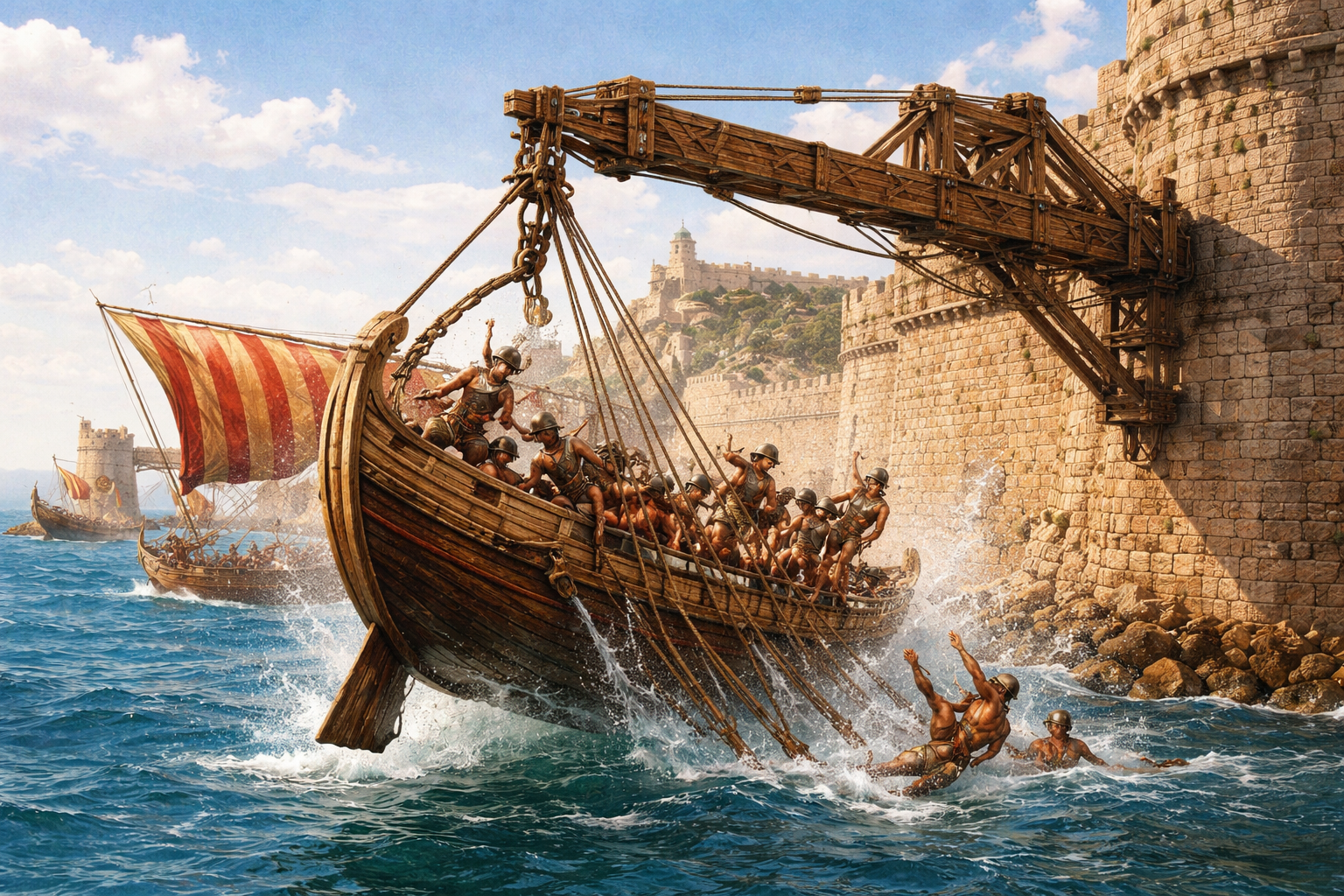
Archimedes built a giant crane-like machine mounted on the city walls. When a Roman ship came close, the Claw would swing out over the wall, drop a grappling hook onto the ship's bow, lift the entire front of the ship out of the water, and then drop it — capsizing or sinking it. Roman sailors were so terrified that if they saw a piece of rope or wood appear over the wall, they would turn and flee. The Roman general Marcellus reportedly joked that Archimedes was using his ships "to ladle seawater" like soup bowls.
The Claw of Archimedes lifts a Roman warship at Syracuse
🔥 The Death Ray (Maybe!) ›
Ancient writers claimed Archimedes used giant mirrors to focus sunlight onto Roman ships and set them on fire. Is it true? Scientists have argued about this for centuries! The TV show MythBusters tried it and said it was "busted." But MIT students tried it in 2005 and managed to set a wooden boat on fire from 100 feet away using 127 mirrors. The truth is probably somewhere in between — Archimedes may have used mirrors to blind and disorient sailors rather than actually set ships ablaze.
🪨 Catapults and Stone Throwers ›
Archimedes designed catapults calibrated to different ranges — some for ships far away, some for ships up close, some that fired through narrow slits in the walls. The Roman fleet couldn't find a safe distance. Too far away and the long-range catapults hit them. Too close and the short-range ones smashed them. The siege that was supposed to take weeks lasted two years because of one man's inventions.
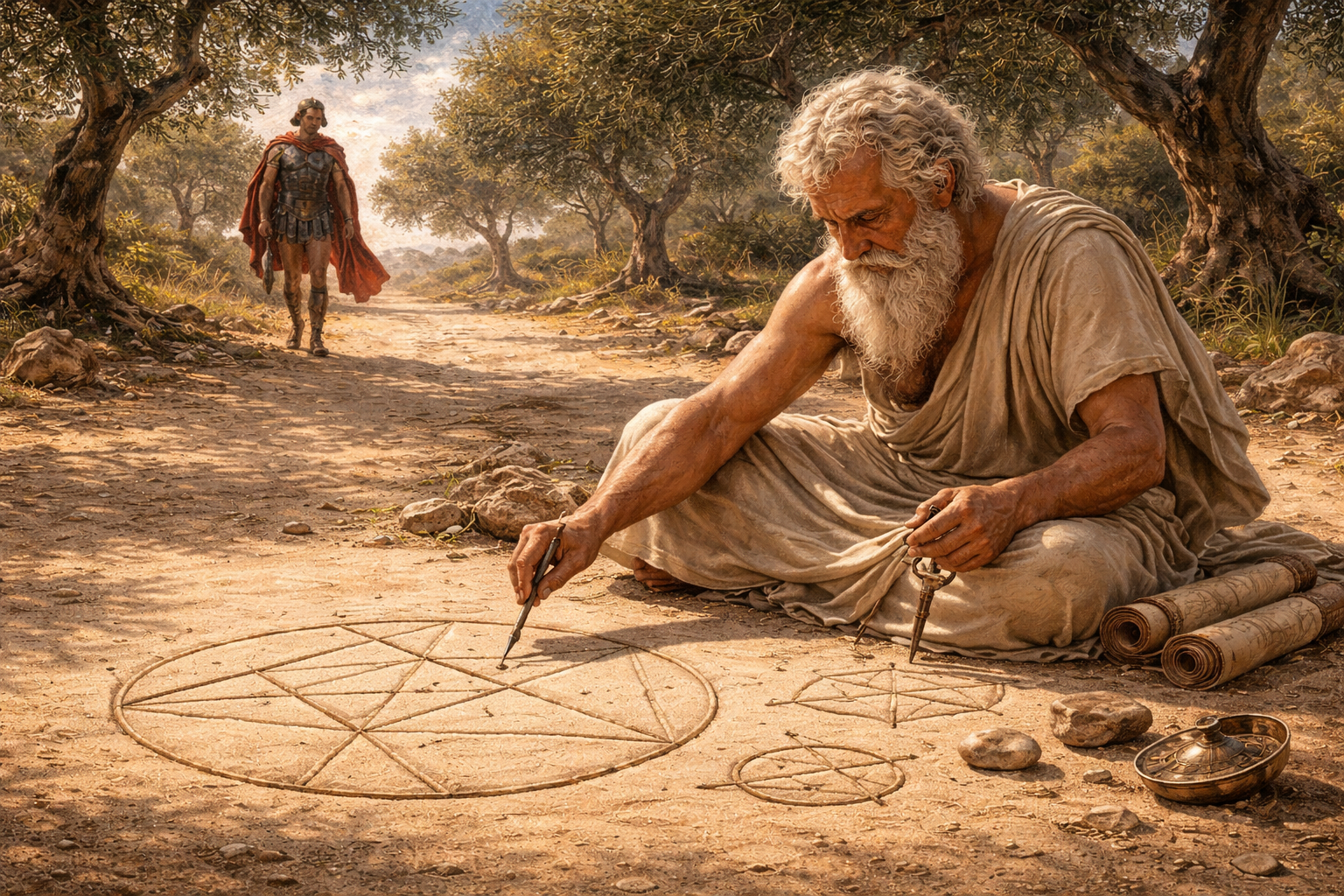
Syracuse eventually fell in 212 BCE — not because Rome beat the machines, but because they found an unguarded section of wall during a festival. Roman soldiers flooded into the city. Archimedes was reportedly working on a math problem when a soldier found him. According to legend, his last words were: "Don't disturb my circles" — he was drawing geometric diagrams in the sand.
The Roman general Marcellus was reportedly furious that his soldiers had killed Archimedes. He had wanted to capture the genius alive. But it was too late.
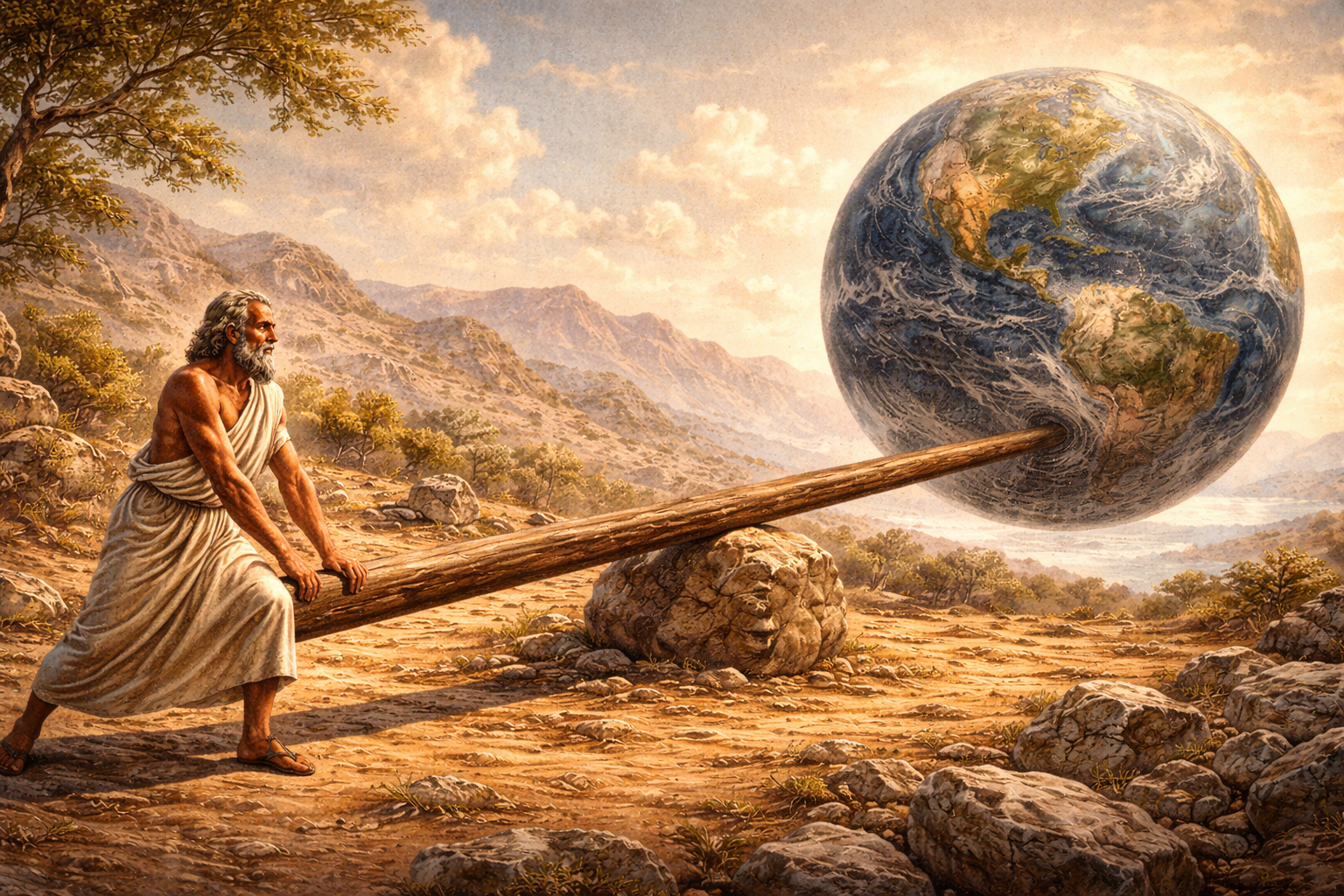
"Don't disturb my circles" — Archimedes' legendary last words"Give me a lever long enough and a place to stand..."
"Give me a lever long enough and a place to stand, and I shall move the world."
Archimedes
🛡️Chapter 6
Cool Tools, Wild Weapons, & Snake Bombs
Ancient warfare wasn't just swords and shields. Hannibal and others used some truly creative (and sometimes gross) tactics.
Weapons of Hannibal's army — falcata, sling, shield with Tanit symbol, and spears
🐍 Hannibal's Snake Bombs ›
Years after leaving Italy, Hannibal was working as a military advisor for King Prusias of Bithynia (in modern Turkey). During a naval battle against King Eumenes of Pergamon, Hannibal ordered his sailors to fill clay pots with live venomous snakes and hurl them onto the enemy ships. The pots shattered on deck, releasing the snakes among the terrified sailors. It worked — Eumenes' fleet panicked and retreated. This is one of the earliest recorded uses of biological warfare in history!
🔥 Vinegar on Rocks ›
During the Alpine crossing, Hannibal's army ran into massive boulders blocking the mountain paths. According to the historian Livy, Hannibal ordered his soldiers to build huge fires against the rocks, get them blazing hot, and then pour sour wine (vinegar) on them. The sudden temperature change caused the rocks to crack and crumble, letting the army pass. Modern geologists say this actually works — it's called thermal shock fracturing!
🐂 The Flaming Oxen Trick ›
When Hannibal was trapped in a valley by a Roman army blocking the only pass, he tied burning torches to the horns of 2,000 oxen and drove them up the hillside at night. The Romans, seeing thousands of moving lights in the darkness, thought Hannibal's entire army was escaping through the mountains. They rushed to block the lights — leaving the actual pass unguarded. Hannibal walked his real army straight through.
⛵ Carthaginian Super-Ships ›
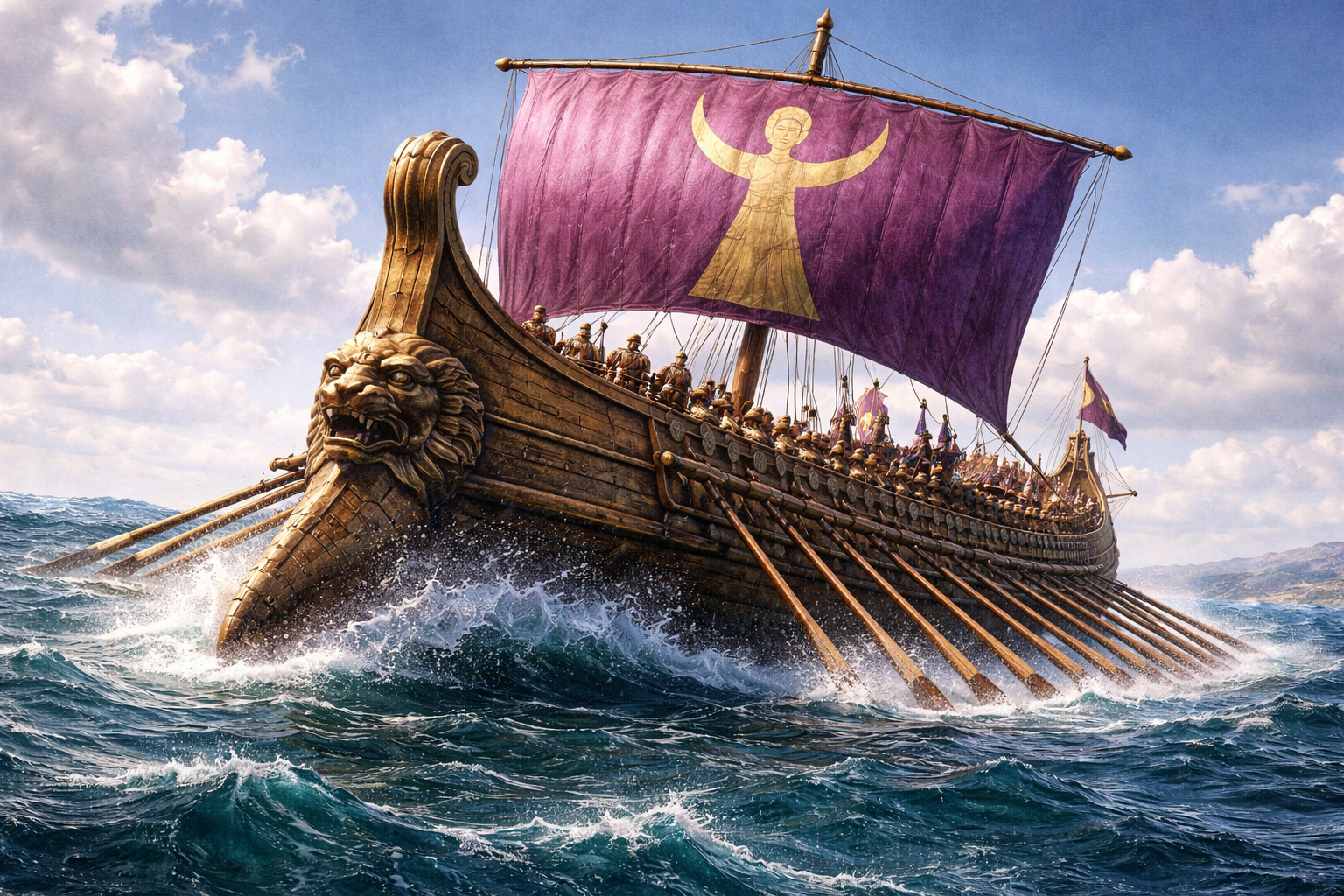
Carthage was the greatest naval power in the Mediterranean. Their warships — called quinquiremes — were powered by five rows of oars on each side, with up to 300 rowers. Carthaginian shipyards could build an entire warship in as little as six days. The harbor at Carthage had a secret inner circular basin where 220 warships could be stored, hidden from enemy view, ready to launch at a moment's notice.
A Carthaginian quinquireme — the mightiest warship in the Mediterranean
🏹 The Balearic Slingers ›
Some of Hannibal's most feared soldiers weren't swordsmen — they were slingers from the Balearic Islands (modern Mallorca and Menorca, off the coast of Spain). They could hurl lead bullets with deadly accuracy at ranges of up to 400 meters — farther than most ancient bows. Balearic boys were trained from childhood; legend says their mothers wouldn't let them eat breakfast until they hit their target. A lead sling bullet traveling at over 100 mph could crack a helmet or break bones even through armor.
Balearic slingers — the ancient world's deadliest sharpshooters
Part IIThe Real Carthage
🔮Chapter 7
What If the Story Changed?
History isn't something that had to happen the way it did. Tiny changes can make enormous differences.
In real history, Hannibal didn't march on Rome. He waited. Rome rebuilt. Eventually, a young Roman general named Scipio — who had survived the Battle of Cannae as a teenager — took the war to Africa and beat Hannibal there. Carthage lost. And eventually, Rome destroyed the city completely, burned all its books, and became the most powerful civilization in the world.
But what if things had gone a tiny bit differently? What if Hannibal had marched? Or what if Carthage's government had sent him the siege equipment he kept asking for? Or what if Rome had agreed to make peace?
That's what the rest of this story imagines. Not a fairy tale — a serious "what if" based on what we actually know.
What Really Happened
Rome wins. Carthage destroyed. All Carthaginian books burned. The world develops on Roman foundations — the calendar, the alphabet, the laws, Christianity, and eventually the world we live in today.
In Our Alternate Story
Carthage wins. Rome becomes a small local power. Everything — science, religion, food, music, medicine — develops along a completely different path. Even the alphabet might be different!
🌍Chapter 8
What Was Carthage?
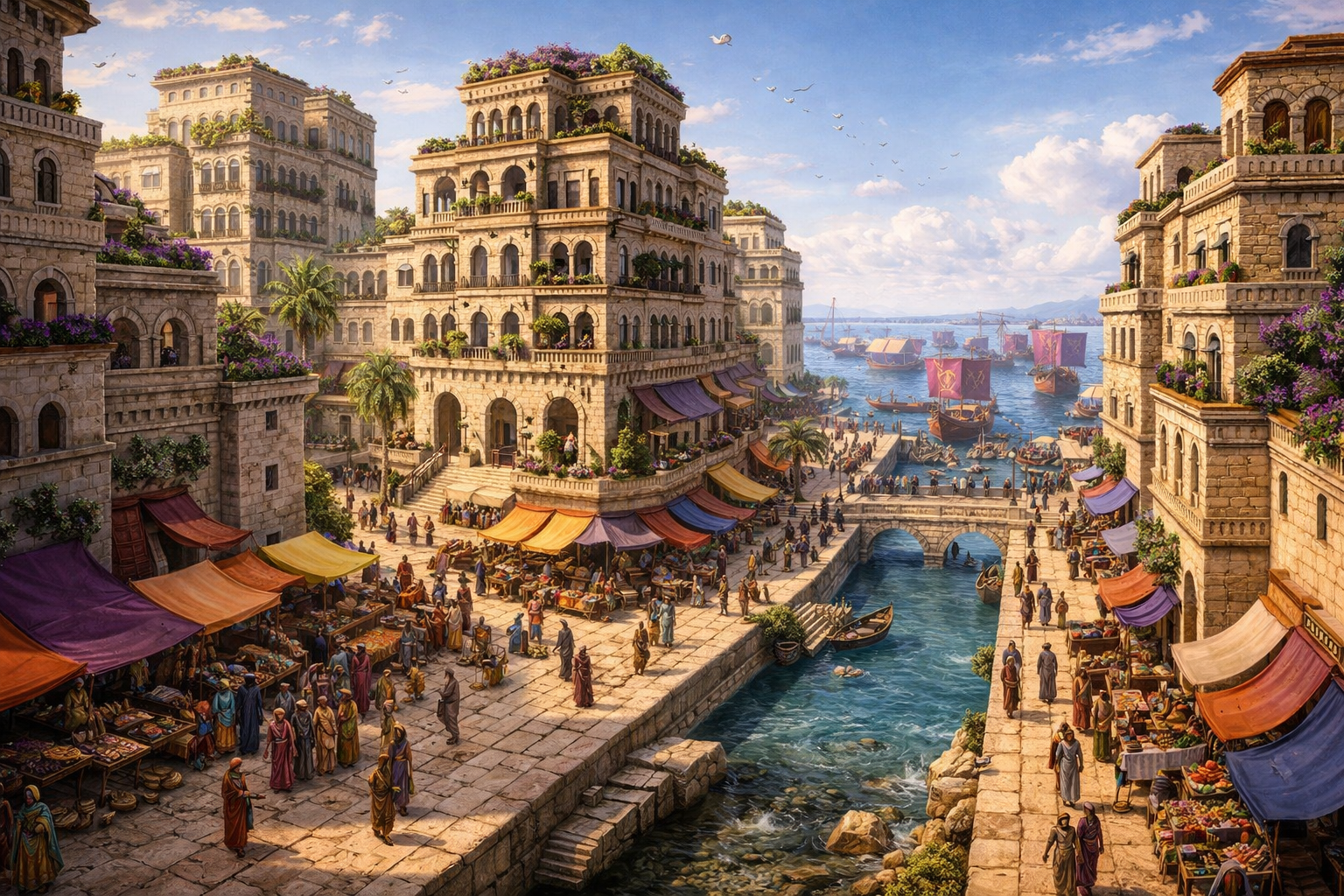
Carthage — six-story buildings, rooftop gardens, and the busiest harbor in the ancient world
Carthage wasn't just a city. It was a massive trading network that connected the entire Mediterranean Sea.
Most of what we "know" about Carthage was written by their enemies — the Romans and Greeks. That's like learning about your school from the kid who hates it most. So we have to be careful.
Here's what we do know: Carthage was incredibly diverse. A huge scientific study in 2025 looked at the DNA of ancient Carthaginian people and found something amazing — they came from everywhere. Sicily, Greece, North Africa, Spain. People from all around the Mediterranean joined because it was a good deal. You could keep your own language, your own customs, your own identity — but you got access to the richest trade routes in the world.
🏗️ Skyscraper City ›
Ancient writers describe Carthaginian buildings as six stories tall — basically skyscrapers in the ancient world. They had a clever water system that collected rainwater from the roof, filtered it through sand to make it clean, stored it underground, and even used evaporation to cool the building. Engineers today are rediscovering these same ideas and calling them "green architecture." Carthage was doing it 2,300 years ago.
Carthage also had a government that the famous Greek philosopher Aristotle called one of the best in the world. They had elected leaders, a senate, and a people's assembly — similar to some modern democracies, but 2,300 years ago.
💰 Ancient Money Masters ›
Carthaginians were so good at trade that they invented a kind of "silent trading" with African tribes. They'd leave goods on a beach, retreat to their ships, and the locals would come out and leave gold next to the goods. The Carthaginians would come back — if there was enough gold, they'd take it and leave the goods. If not, they'd wait. Back and forth until both sides were happy. No shared language needed! The Greek historian Herodotus wrote about this with amazement.
🟣 The Color of Kings ›
The word "Phoenician" (the culture Carthage came from) literally means "purple people" in Greek — because they were famous for making Tyrian purple dye from murex sea snails. This dye was so expensive that only kings and emperors could afford it. One pound of dye cost the same as three pounds of gold! The phrase "born to the purple" (meaning born royal) comes from this tradition. Cleopatra's royal sails were dyed Tyrian purple.
🦁Chapter 9
Animals of the Ancient World
The ancient Mediterranean was full of animals that are now rare, endangered, or completely extinct — and they played huge roles in history.
🐘 The War Elephants of Carthage ›
Most of Hannibal's elephants were probably North African forest elephants — a now-extinct species about 2.5 metres at the shoulder (compared to 3.5 metres for the African bush elephants in zoos today). Ancient coins from Carthage show these smaller elephants. But his personal elephant, Surus ("the Syrian"), was likely a Syrian elephant — a subspecies of the Asian elephant that also went extinct around this time. Surus was larger, had one broken tusk, and wore a red cloth. Some accounts say he carried a small wooden tower on his back so Hannibal could see the battlefield (Hannibal had lost sight in one eye from an infection). Both species were driven to extinction — the North African elephant disappeared during Roman times, partly from being captured for arena games.
🐎 The Numidian Horse ›
Hannibal's secret weapon wasn't elephants — it was Numidian cavalry, the finest horsemen in the ancient world. They came from North Africa (modern Algeria and Tunisia) and rode small, incredibly tough horses without saddles or bridles. They controlled their horses using just their knees and a small stick. They could throw javelins at full gallop, wheel around in an instant, and harass enemy armies for hours without getting caught. At Cannae, it was the Numidian cavalry that closed the trap.
Numidian cavalry — riding without saddles, the finest horsemen in the ancient world
🦁 Barbary Lions ›
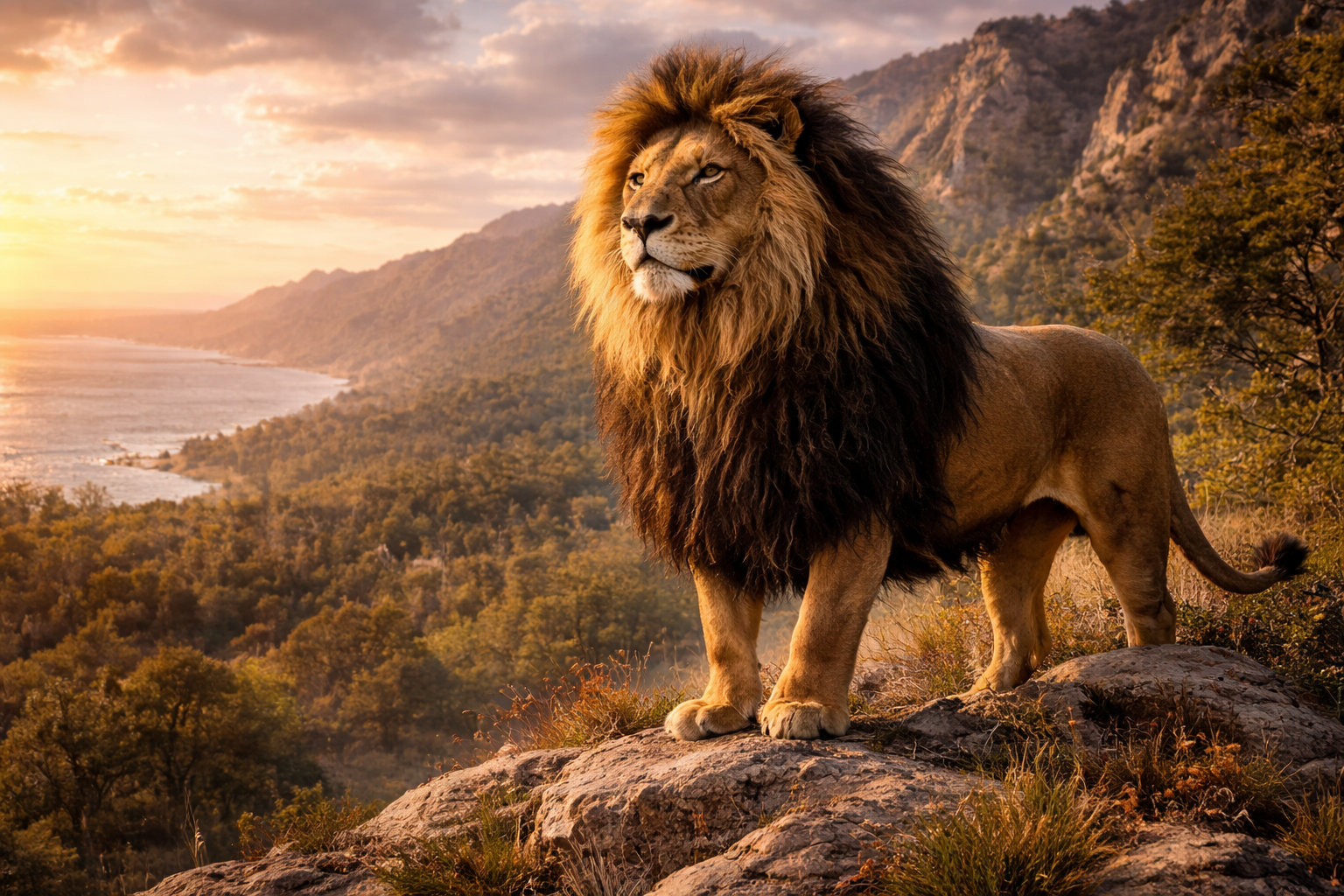
North Africa was once home to the Barbary lion — the largest lion subspecies ever known, with magnificent dark manes that extended to their bellies. Carthaginians encountered them regularly. Roman arenas later slaughtered thousands of them for entertainment, and the last wild Barbary lion was shot in Morocco in 1920. They survive only in a few zoos today. In the alternate timeline, without Roman arena games driving them to extinction, Barbary lions might still roam North Africa.
The Barbary lion — the largest lion ever known, now functionally extinct
🐚 The Murex Snail ›
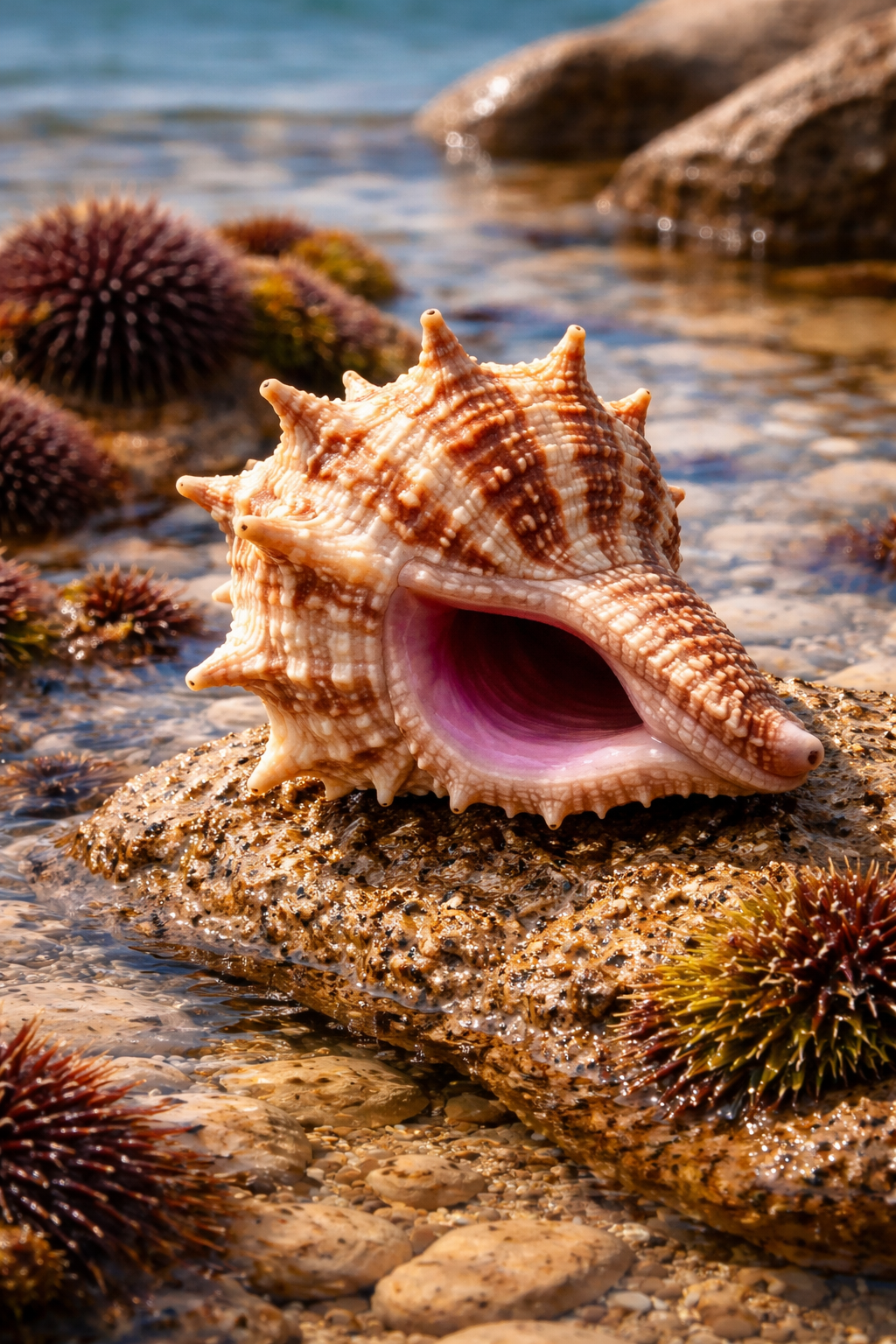
The tiny murex snail was the most economically important animal in Carthage. Each snail produces just a single drop of mucus that can be processed into purple dye. To make enough dye for one garment, you needed about 12,000 snails. At one dye factory in Sidon (modern Lebanon), the discarded shells formed a hill 40 meters high — roughly as tall as a 13-story building. That's a LOT of snails.
The murex snail — this tiny creature produced the most valuable substance in the ancient world
🦍 Hanno's Gorillas ›
When the Carthaginian explorer Hanno sailed down the African coast around 500 BCE, he encountered large, hairy creatures that his translators called "gorillai." He tried to capture some but they fought back fiercely, biting and scratching. He brought three skins back to Carthage and hung them in the temple of Tanit. The English word "gorilla" actually comes from Hanno's report! When scientists named the great apes in 1847, they borrowed his word.
⚡Chapter 10
Ancient Batteries and Computers
The ancient world already had a computer and possibly a battery. They just didn't know what to do with them yet.
🔋 The Baghdad Battery ›
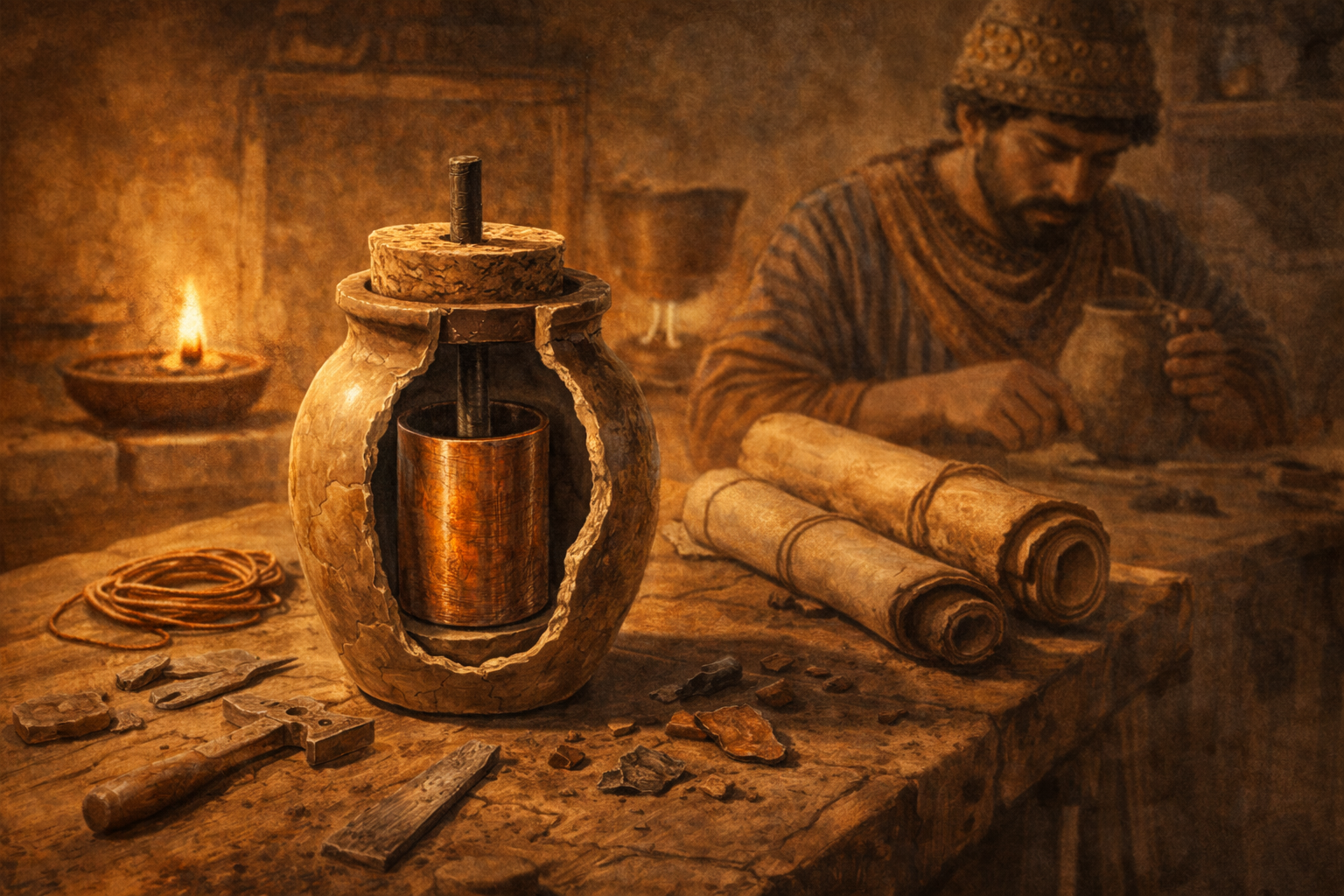
Archaeologists found clay jars in Iraq dating to around 250 BCE that contain a copper cylinder and an iron rod. When you fill them with vinegar or grape juice, they produce about one volt of electricity. Scientists call them "Baghdad Batteries." Were they actually used as batteries? Nobody knows for sure — they might have been used for electroplating jewelry with thin layers of gold. But the point is: the phenomenon of electricity was right there, waiting to be understood. The Greek word elektron (meaning amber) is where we get the word "electricity" — because the Greeks noticed that rubbing amber on fur made it attract things. They just never figured out what was happening.
The Baghdad Battery — a 2,250-year-old clay jar that produces electricity
⚙️ The World's First Computer ›
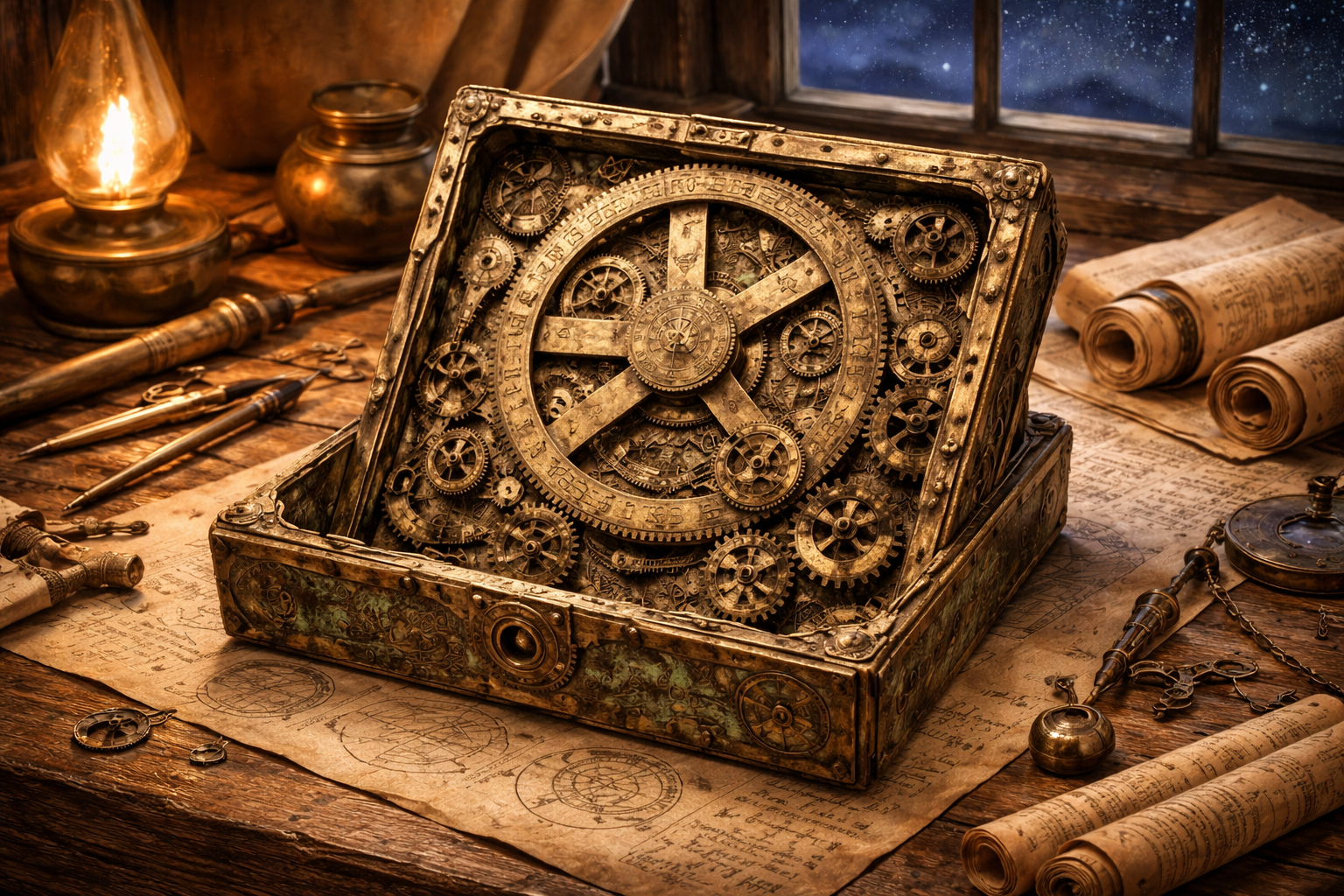
Remember the Antikythera mechanism? That 2,100-year-old device with 37 bronze gears? It wasn't just a clock — it was a computer. It could calculate the positions of the Sun and Moon, predict eclipses, and even figure out when the next Olympic Games would be. Meanwhile, Hero of Alexandria built machines that could follow a set of programmed instructions using ropes and counterweights — basically ancient robots! In our timeline, nobody built anything this complex again for over 1,400 years. In the alternate world, with no interruption, these traditions keep developing. Imagine: mechanical computers by the year 500 CE, calculating everything from trade routes to tides.
💡 From Amber to Light Bulbs ›
In our world, it took until the 1800s to go from "rubbing amber is weird" to "electricity powers cities." That's because understanding electricity requires a huge insight: electricity and magnetism are the same force. A scientist named James Clerk Maxwell figured this out in 1865. In the alternate world, that insight could come earlier — the Carthaginian dye industry was already doing electrochemistry (using electricity to drive chemical reactions) without knowing it. Workers dipping metals in acidic dye solutions would have noticed galvanic effects — tiny sparks, metals dissolving strangely. A civilization that's curious about why things happen (instead of just accepting them) could follow that trail to electric motors and light bulbs centuries ahead of our timeline.
Our World
First battery: 1800. First electric motor: 1831. First power grid: 1882. First computer: 1940s. That's 2,000 years from the Baghdad Battery to your laptop.
Alternate World
Mechanical computers developing from ~200 BCE onward. Electrochemistry discovered through dye workshops. Electricity understood centuries earlier. The gap between discovery and everyday use is shorter because the civilization is already set up to use new technology.
🔬 Try This!
Rub a balloon on your hair (or a wool sweater), then hold it near small pieces of paper. Watch them jump! Congratulations — you just did the same experiment Thales of Miletus did in Greece 2,600 years ago. He noticed that rubbing amber on fur made it attract things. The Greek word for amber? Elektron. That's where we get the word "electricity."
🧭Chapter 11
The Greatest Explorers You've Never Heard Of
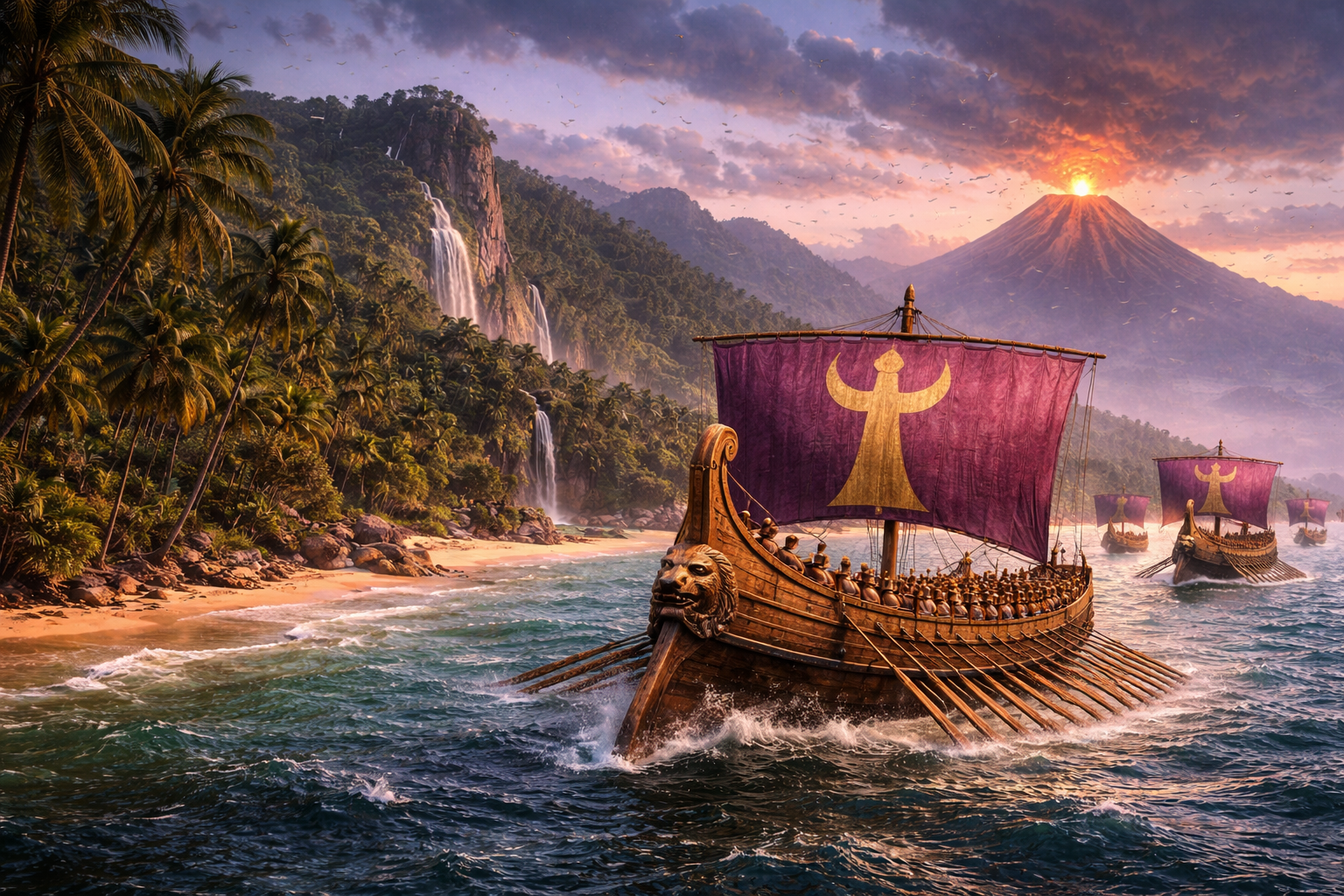
Hanno's fleet sails the African coast — volcanoes, jungles, and the unknown
Carthaginians were exploring the world nearly 2,000 years before Columbus — and they went further than you'd believe.
⛵ Hanno's African Expedition ›
Around 500 BCE, a Carthaginian commander named Hanno the Navigator set out with 60 ships and 30,000 colonists to explore the west coast of Africa. He sailed past the Sahara desert coastline, through tropical rivers, past erupting volcanoes ("a great fire that seemed to touch the stars"), and possibly as far as modern Cameroon or Gabon. Nobody from Europe would go that far again until the Portuguese, almost 2,000 years later. Hanno wrote about everything he saw, and his report — the Periplus — is the only Carthaginian text that survived Rome's destruction.
🇬🇧 Himilco Reaches Britain ›
Around the same time as Hanno's African voyage, another Carthaginian explorer named Himilco sailed north — up the Atlantic coast of Europe all the way to Britain and possibly Ireland. He was looking for tin, which was essential for making bronze. He reported "vast seaweed" (probably the Sargasso Sea currents), sea creatures, fog, and shallow waters. The Carthaginians kept these trade routes secret so nobody else could access the tin supply.
🗺️ Secret Maps ›
Carthage deliberately kept its navigation knowledge secret. Ancient sources say that Carthaginian captains were ordered to deliberately wreck their ships rather than let enemies capture their charts and sailing directions. One captain who accidentally led a Roman ship to a secret trade route was rewarded by the Carthaginian government — for sinking his own ship before the Romans could figure out where they were going! Trade secrets were serious business.
🌊 Could They Have Reached America? ›
This is one of history's great "maybes." We have no proof that Carthaginians reached the Americas. But we know they had the ships, the navigation skills, and the Atlantic sailing experience to make it possible. The trade winds from West Africa to the Caribbean are steady and reliable — Columbus used them in 1492. Some researchers have pointed to ancient coins and pottery found in the Americas that might be Phoenician, but nothing is proven. In our alternate story, we imagine this happens — but honestly, it's a big "what if" on top of a "what if."
~2,000
Years before Portugal repeated Hanno's African voyage
Part IIIThe Alternate World
🔬Chapter 12
Science That Could Have Been
The ancient world was smarter than you think. And Rome may have slowed science down by centuries.
Here's something wild: a Greek scientist named Aristarchus figured out that the Earth goes around the Sun in 270 BCE. That's almost 1,800 years before Copernicus got credit for the same idea!
And Archimedes — the genius from Syracuse — was working on math incredibly close to calculus. He was killed by a Roman soldier. His work survived only in bits and pieces.
⚙️ The Ancient Computer ›
In 1901, divers found a corroded lump of metal in a shipwreck near the Greek island of Antikythera. It turned out to be a 2,100-year-old computer — a device with 37 interlocking bronze gears that could track the movements of the Sun, Moon, and planets, predict eclipses, and even calculate the dates of the Olympic Games. Nobody in Europe built anything this complex again for over 1,400 years. Scientists are still figuring out exactly how it worked.
The Antikythera mechanism — a 2,100-year-old computer
🐚 The Magic Snail → Microscopes ›
The Carthaginians made Tyrian purple dye from murex snails using complex chemistry — controlling reactions that scientists today call organic chemistry. In our alternate story, this 800-year tradition of snail chemistry leads to better glass (because dye-makers needed clear glass to control color with UV light), which leads to lenses, which leads to microscopes, which leads to discovering germs — possibly 1,200 years before Pasteur did in our world!
💨 The First Steam Engine ›
Around 60 CE, a Greek inventor named Hero built a device called an aeolipile — a metal ball that spun when steam shot out of two nozzles. It was the world's first steam engine! But in the ancient world, where slaves did most of the hard labor, nobody needed a machine to do work. The aeolipile was treated as a cool toy. In our alternate world — where a trading civilization needs efficiency more than slave labor — someone might have turned this toy into an engine centuries before the Industrial Revolution.
Our World
Germ theory discovered in 1861. Before that, nobody knew why people got sick. The Black Death killed 30–60% of Europe because nobody understood bacteria. Doctors didn't wash their hands before surgery until the 1860s.
Alternate World
With microscopes centuries earlier, someone looks at water and sees tiny organisms. Germs are understood much sooner. Doctors wash their hands. Clean water systems are designed to prevent disease. The Black Death might never happen.
🌏Chapter 13
A Different World
If Carthage won instead of Rome, the ripples would have reached every corner of the planet.
No Christianity or Islam — at least not in the forms we know. Remember, Christianity spread through the Roman Empire. But it goes deeper: Jesus himself was a product of Roman occupation. The Roman taxes that crushed farmers, the Roman soldiers that occupied the land, the Roman governor Pontius Pilate — all of these created the conditions for the messianic movement that became Christianity. No Rome, no Roman occupation of Judea, no specific pressures that produced the Jesus story as we know it.
✡ What Happens to the Jewish People? ›
This might be the biggest change of all. In our timeline, Rome destroyed the Jewish Temple in 70 CE — the center of Jewish religious life. Then Emperor Hadrian expelled Jews from Jerusalem in 135 CE, beginning 2,000 years of exile. Without Rome, the Temple still stands. There's no exile, no diaspora, no "Next year in Jerusalem" (because they never left). There's no Christian antisemitism — no one blaming Jews for the death of Christ, because Christ as we know him doesn't exist. No Spanish Inquisition. No pogroms. No Holocaust — because the entire chain of persecution requires Christianity, which requires Rome. Jewish communities still trade across the Mediterranean (Phoenician and Jewish merchant networks overlapped for centuries), but they live as neighbors, not refugees. Judaism becomes a confident, outward-facing religion rather than one shaped by 2,000 years of trauma and survival.
✝️ What About Christianity? ›
Remember what we learned in Chapter 1? Christianity is one of the biggest things Rome gave the world — over 2 billion people follow it today. Without Rome, it simply doesn't develop in any form we'd recognize. Jesus was born in Roman-controlled Palestine, tried by a Roman governor, and crucified using a Roman method of execution. The religion spread on Roman roads, was legalized by a Roman emperor, and was made the official religion of the Roman Empire. Take away Rome and every single link in that chain breaks.
Think about everything that flows from Christianity: Christmas, Easter, church steeples in every town, the entire structure of the calendar (BC/AD), cathedrals, gospel music, the concept of "turning the other cheek," hospitals (many were founded by churches), universities (Oxford, Cambridge, Harvard — all started as religious schools), and the idea that all people are equal before God. Also: the Crusades, the Inquisition, witch trials, religious wars that killed millions, and the use of religion to justify conquering other countries and enslaving people. Christianity produced both extraordinary beauty and extraordinary violence. In the alternate world, none of it exists — not the good parts and not the bad parts. That's not a simple gain or a simple loss. It's a completely different world.
☪ What About Islam? ›
Islam as we know it doesn't develop either — and this is a huge loss for world civilization. Muhammad's revelation emerged from very specific conditions: wars between the Byzantine and Persian empires, Christian communities in Arabia, Jewish tribes in Medina. Without Christianity and without the Byzantine Empire (which was the Eastern Roman Empire), these conditions don't exist. That means: no Umayyad Caliphate, no Abbasid Golden Age (which gave us algebra, the number zero, and modern optics), no Ottoman Empire, no Mughal Empire (which built the Taj Mahal), no Rumi's poetry, no Sufi music. The people still exist — Arabs, Persians, Turks — but they organize around different traditions. The specific brilliance of Islamic civilization is one of the things the alternate world genuinely loses.
The Americas — In our world, Europeans reached the Americas in 1492 and brought diseases that killed tens of millions of Indigenous people. In the alternate world, if Carthaginian traders arrived centuries earlier as friends wanting to trade (not as conquerors), the Maya, Aztec, Inca, and other civilizations might have survived and thrived.
Africa — Carthage was an African city! Without the transatlantic slave trade (which took 12.5 million Africans from their homes) and without European colonization, African civilizations would have developed on their own terms. The great university at Timbuktu, the gold of the Mali Empire, the stone cities of Great Zimbabwe — all continuing to grow.
🌶️ Chili Peppers, 1,000 Years Early! ›
In our world, chili peppers didn't reach Europe until Columbus brought them back in the 1490s. In the alternate world, if Carthaginian traders reached the Americas around 400 CE, chili peppers could have entered Mediterranean cooking more than a thousand years earlier. Also: tomatoes, potatoes, chocolate, and vanilla. Imagine ancient Carthaginian chocolate!
🇨🇳 What About China? ›
China's big inventions — paper, the compass, gunpowder, and printing — all happen regardless of events in the Mediterranean. But the trade changes a lot. Chinese inventions might reach the West much faster through an unbroken trade network, and Mediterranean glass and optical technology would flow east. Imagine Chinese astronomers with Mediterranean telescopes in 600 CE!
🇯🇵 Japan Never Closes ›
In our world, Japan closed its borders to almost all foreigners in 1639 because they were worried about European missionaries and colonizers. Without European colonial pressure, Japan never needs to close. Instead, Japanese culture develops in open exchange with the world — trading samurai swords for Mediterranean glass, sharing art techniques, and blending musical traditions. The result might be something nobody in our world has ever experienced.
🍽️Chapter 14
What Would the Food Taste Like?
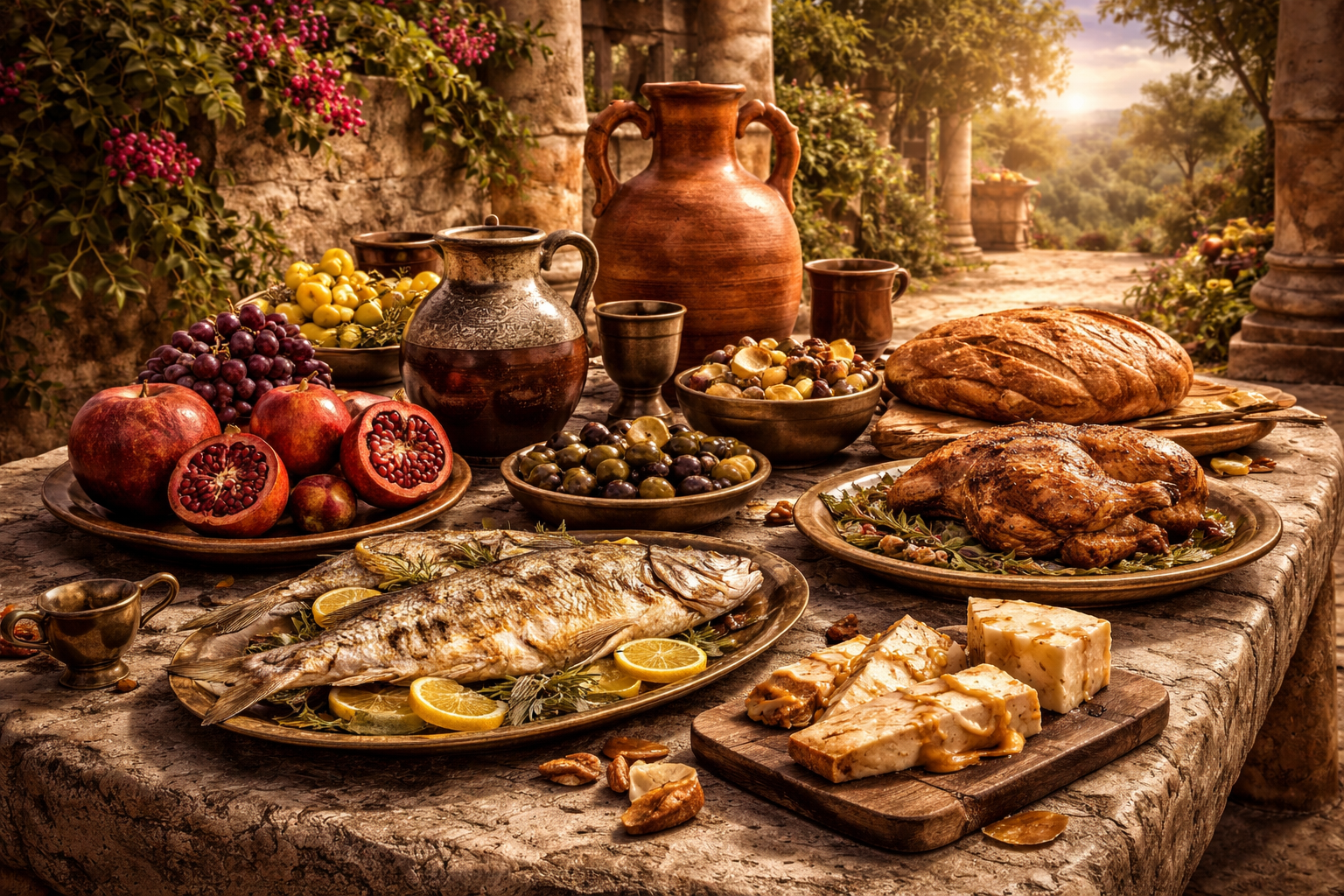
A Carthaginian feast — grilled fish, pomegranates, olives, bread, and cheese
The alternate world's food would be built on three things: fermented fish sauce, snail chemistry, and spices from every continent.
The Carthaginians made something called garum — a fermented fish sauce that was the ketchup of the ancient world. People put it on everything. It was rich, salty, and full of umami — that deep, satisfying flavor you taste in soy sauce, parmesan cheese, and ramen broth.
1,000,000
Litres of fish sauce · one factory in Morocco
📚 28 Books About Farming ›
A Carthaginian writer named Mago wrote 28 entire books about farming — covering everything from when to plant, how to graft fruit trees, how to keep bees, and how to make wine. When Rome destroyed Carthage, they burned the entire library — except Mago's farming books. They translated all 28 volumes into Latin because the farming advice was too good to destroy. That tells you how smart Carthaginian agriculture was!
🍫 Ancient Chocolate? ›
If Carthaginian traders reached the Americas, they would have encountered cacao — the plant that chocolate comes from. The Maya were already making chocolate drinks by 600 BCE. In the alternate world, chocolate might have reached the Mediterranean by ~400 CE — over a thousand years before Europeans tasted it. Imagine Carthaginian hot chocolate, sweetened with honey and spiced with cinnamon from Sri Lanka!
🧀 Cheese From Everywhere ›
With an understanding of microbiology from germ theory (in the alternate world), cheese-making goes from an art to a science. Instead of discovering good cheese cultures by accident (which is how most of our favorite cheeses were invented), alternate-world cheesemakers would understand why certain bacteria make certain flavors. The cheese selection in the alternate 2026 would make a fancy French cheese shop look like a beginner's practice run.
😋 A Taste Test ›
Imagine a meal in the alternate 2026: A bowl of spiced grain with garum-based sauce perfected over 2,500 years. Grilled fish with chili peppers that arrived from the Americas 1,600 years ago. Cheese cultured with precision microbiology. Bread made with sourdough understood at the molecular level. Chocolate for dessert, spiced with cardamom from India. All of it more complex, more layered, and more delicious than anything in our world — because the flavor traditions had 1,000+ extra years to develop.
🔬 Try This!
Next time you use ketchup, think about this: garum was the ketchup of the ancient world — a fermented sauce people put on everything. And next time you use soy sauce, you're tasting the same type of flavor (umami!) that Carthaginian garum had 2,500 years ago. Same idea, different continent, separated by thousands of years. Some inventions are so good that humans keep reinventing them.
Part IVThinking Critically
⚔️Chapter 15
But Wait — Who Challenges Carthage?
History doesn't leave vacuums. If Carthage controls the richest trade routes on Earth, someone's going to want to take them.
This is the question every good historian would ask: okay, Rome is gone — but doesn't someone else become the next Rome? Let's look at the candidates:
🏛️ Macedon — The Ghost of Alexander ›
Alexander the Great had already proved that a Greek army could conquer everything from Egypt to India in just ten years. Without Rome absorbing Greece, Greek military culture stays dangerous. A new Alexander turning west instead of east? Totally possible. But Greek empires had a problem: they were brilliant at conquering but terrible at keeping what they conquered. Alexander's empire fell apart the moment he died. A Greek challenge to Carthage would be a lightning strike — dazzling but unsustainable.
🏺 Egypt — The Real Rival ›
Ptolemaic Egypt is probably Carthage's most serious competitor. They controlled Egypt's grain (whoever feeds the cities has power over everyone), they had the biggest navy in the eastern Mediterranean, they held Alexandria (the world's intellectual capital), and they controlled the trade routes to India through the Red Sea. But here's the thing: the Ptolemies never had imperial ambitions like Rome did. They wanted to hold Egypt and protect their trade, not conquer the world. So Egypt would be a commercial rival — trade wars, grain embargoes, proxy conflicts over Sicily — but not an enemy trying to burn Carthage to the ground. That's exactly what makes Rome unique.
🗡️ The Gauls? Nope. ›
You might think the Celtic tribes of Europe (the Gauls) could unite and challenge Carthage — after all, they sacked Rome in 390 BCE! But here's what most people miss: Gallic military coalitions only formed because Rome was conquering them. Vercingetorix united the tribes in 52 BCE specifically because Julius Caesar was invading. Without Roman aggression, Celtic tribes have no reason to stop being what they naturally were: dozens of independent groups trading, raiding, and feuding with each other. A Carthaginian trade ship pulling into a Gallic harbor? That's a welcome customer, not an invader. The Gauls are not a threat to Carthage. They're customers.
🤔 The Honest Answer ›
Probably nobody becomes the next Rome — because Rome was genuinely one-of-a-kind. Think about what made Rome special: citizen-soldiers who were also farmers, a culture that absolutely refused to accept defeat (no other ancient state lost 70,000 soldiers in an afternoon and kept fighting!), and an incredible ability to turn conquered people into Romans within a generation. No other civilization had this combination. The Greeks were brilliant but fragile. The Persians were organized but defensive. The Celts were fierce but tribal. The alternate world probably faces lots of smaller challenges — a Macedonian invasion here, a Persian trade war there — but never a single enemy that threatens everything the way Rome did.
⚖️Chapter 16
The Honest Truth
The alternate world isn't paradise. Carthage had real problems, and some bad things would still happen — just different bad things.
💰 Rule by the Rich ›
Carthage was run by wealthy merchant families. Even Aristotle, who praised their constitution, noticed that rich people had way more power than everyone else. A world built on the Carthaginian model doesn't escape this problem — it just organizes it differently. Instead of kings and nobles controlling everything (like in medieval Europe), wealthy traders and bankers control everything. Sound familiar? That's because some version of this problem exists in every civilization, including ours.
⛓️ Slavery Doesn't Just Disappear ›
The alternate world probably doesn't have the transatlantic slave trade (which required European colonialism and Christian theology). But slavery existed in every ancient civilization, including Carthage. The good news: a trade civilization needs skilled, educated workers — and you can't get good work from people you're forcing to work. So market forces push against slavery over time. Ancient philosophers like Seneca already argued that slaves were moral equals. Buddhist traditions rejected the whole idea of social hierarchy. The alternate world probably abolishes slavery earlier than ours — but it also probably develops new forms of unfair labor: debt traps, exploitative contracts, workers who are technically "free" but have no real choice. Every economic system finds ways to take advantage of vulnerable people. Honesty requires admitting that.
🏴 Trade Can Be Its Own Kind of Bully ›
You don't need an army to exploit people. A civilization that controls all the trade routes can set unfair prices, lock out competitors, and make smaller communities dependent on goods they can't produce themselves. Carthage already did some of this — their trade treaties included zones where nobody else was allowed to trade. That's not as violent as conquest, but it's still power being used over weaker people. The alternate world avoids colonialism but probably invents its own forms of economic bullying.
🔥 What Rome Gave Us ›
Here's something important: Rome wasn't all bad. Roman law — the idea that you're innocent until proven guilty, that laws should be written down, that everyone should be treated equally under the law — is the foundation of legal systems used by half the world today. Roman roads connected an entire continent. Roman political ideas directly inspired the American and French revolutions. The alternate world has to reinvent all of these things from scratch, and there's no guarantee it does as good a job. Losing Rome means losing real achievements, not just avoiding real harms.
The point of this story isn't that the alternate world would be better. It's that it would be different — with different strengths, different problems, and different forms of unfairness. The real lesson is that our world's specific problems weren't inevitable. They were the result of specific choices and specific accidents. And that means we can still choose differently going forward.
🌟Chapter 17
What Does It All Mean?
The point isn't that the alternate world would be perfect. It's that the world we live in didn't have to be this way.
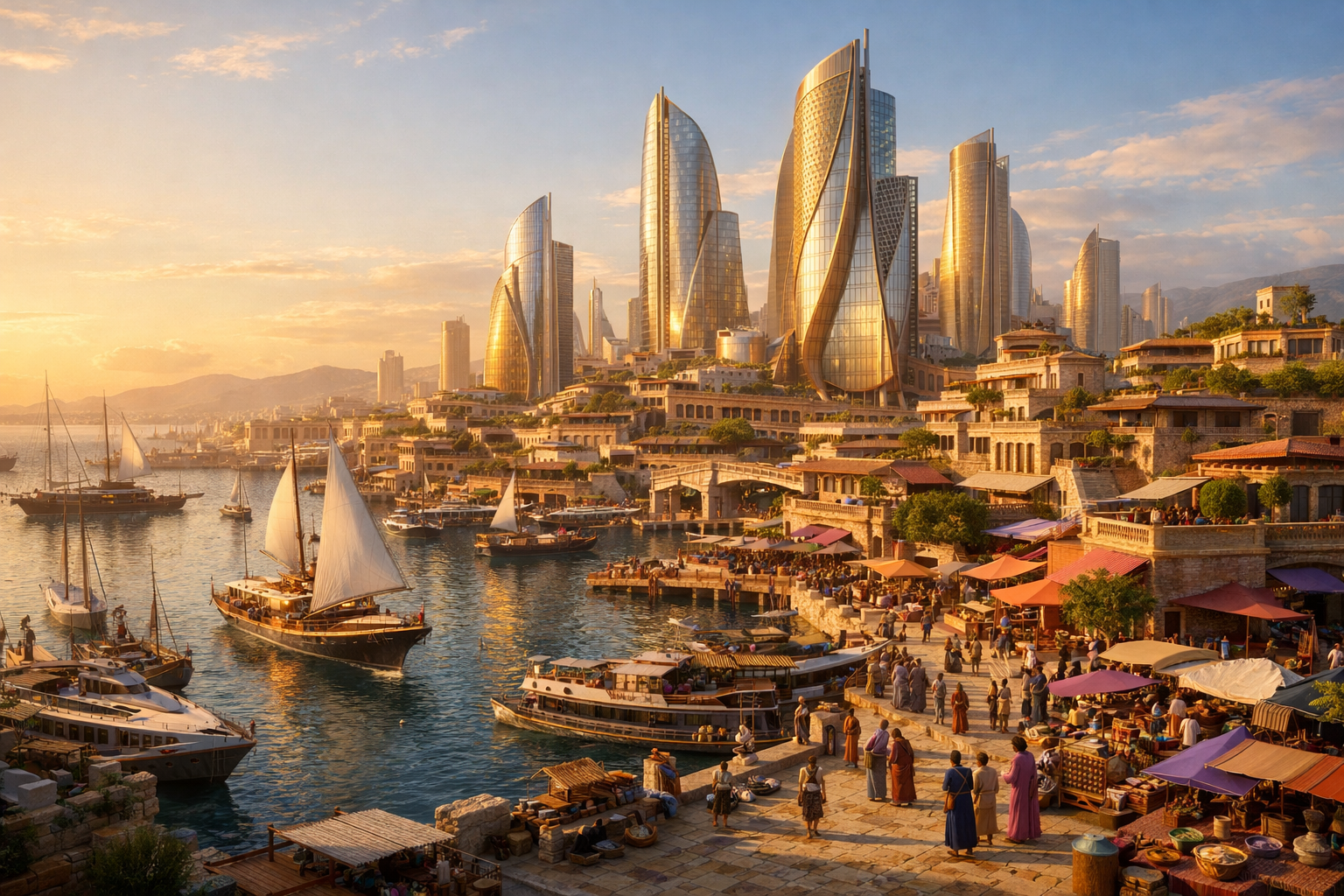
The alternate 2026 isn't paradise. People still argue, compete, and sometimes fight — that's just human nature. But some of the worst things in our history might never have happened.
And some things would be much further ahead: medicine, clean cities, and a world where different civilizations traded with each other as equals instead of one group conquering everybody else.
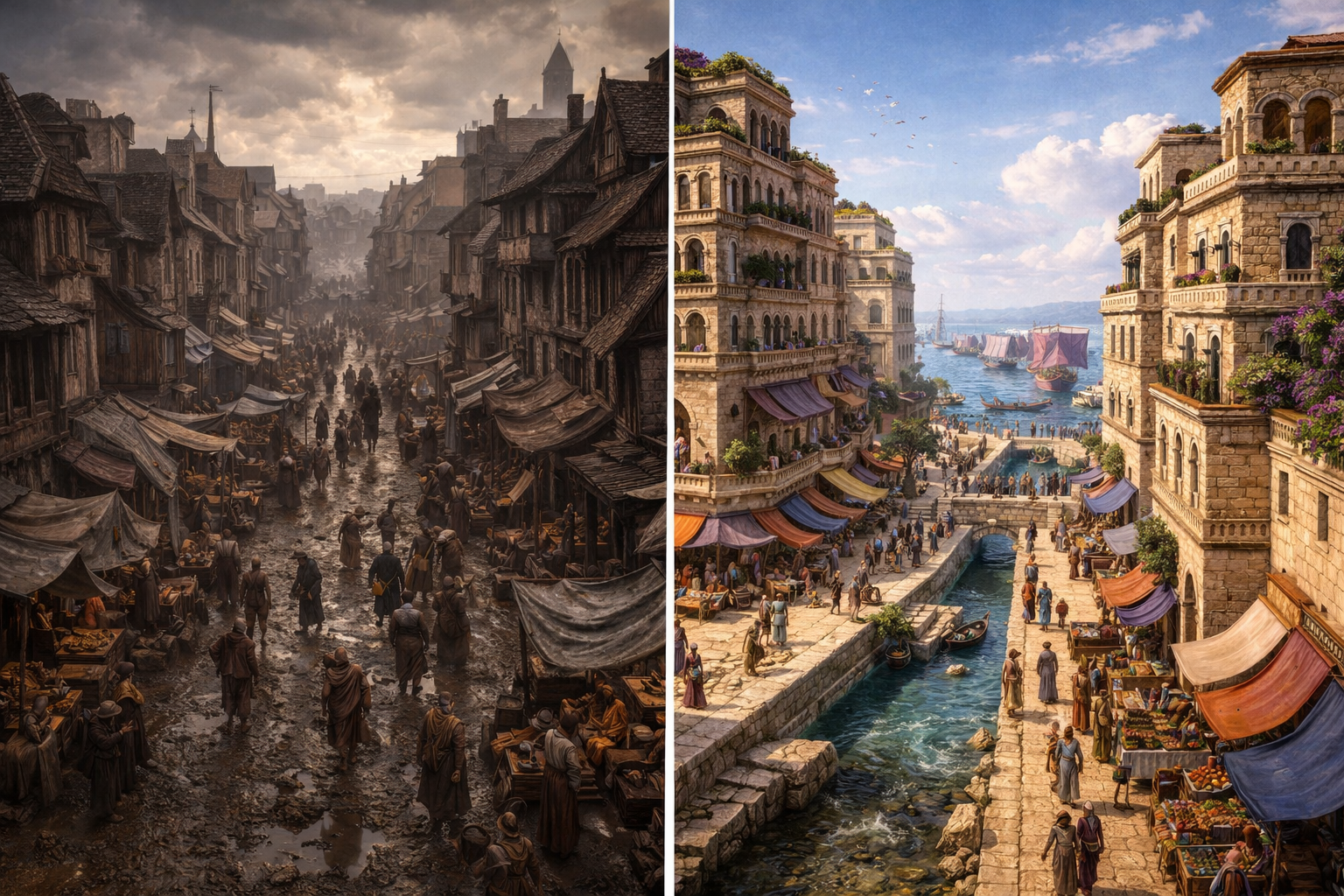
Same year, different worlds — medieval Europe vs. the alternate Carthaginian city
But here's the most important idea: almost nothing about our world was inevitable. The world you're growing up in is the result of specific decisions, specific accidents, and specific moments where history could have gone another way. One of those moments was a hot afternoon in southern Italy, 2,200 years ago, when a general decided not to march.
Now you know the story. And here's the question only you can answer: if you could change one moment in history, what would you change?
The world that might have been — alternate Carthage, 2026
"History is not about what happened. It is about what could have happened — and what that teaches us about tomorrow."